Sunday, December 07, 2008

From the vault: Villa of the Mysteries

This review originally appeared in issue #185 of The Comics Journal, which was a looong time ago.

The Villa of the Mysteries #1
by Mack White
Fantagraphics Books

“The Villa of the Mysteries,” a new collection of comics by Texas artist Mack White, takes its name after a famous frieze in Pompeii, the largest surviving Roman wall painting in existence. The ancient work’s real fame, however, rests on its disturbing depiction of a Dionysian ritual.

In one section of the frieze, which White reproduces on the cover of his comic, a female with large dark wings is shown whipping a young initiate, possibly, some speculate, to prepare her for the marriage bed. Whatever is going on in that scene, however, it is a pretty safe bet that White has managed to get his finger on the same pulse.

“Villa of the Mysteries” is obsessed with pagan rituals, especially those involving Dionysus, the Greek god of wine, fertility, and general all-out sexual abandonment. He and his cousin Pan, the god of nature, pop up either symbolically or literally in each of these short stories.

In between those ancient references, he throws in a dollops of Christian symbolism as well, as a reminder that the line between Jesus Christ and Bacchus is a thin one. In an introduction that would make a modern mythology major proud, he writes, "Jesus is another of his [Dionysus] incarnations . . . Yet in the translation something was lost. The sexual, animal aspect of the god, deemed incompatible with Jesus' image, was projected onto Satan, and what was natural now became evil." Part of the purpose of White's book then, is to tip the scales in favor of the pagans.

White rolls up his sleeves and dives in with the first story, the unsubtly titled "This is MK-Ultra, Baby." In the comic, big name rock star Dion Nysos (get it?) has arrived to the uptight Texan town where he was raised and abused as a child by his hypocritical aunt. While there, he spikes the punch at a party with an CIA developed aphrodisiac, causing a (dare I say it?) Dionysian frenzy.

Yet things don't turn out quite as planned. It seems there are a number of covert government intelligence groups out to get Dion as well, and the tables end up being unexpectedly turned on him.

As "MK-Ultra's" title suggests, White is not content with simply drawing pagan rituals and orgies. He also seems to have a genuine fondness for pulp literature and conspiracy theories involving UFOs, the U.S. government, and the Vatican. There's enough subversiveness in this one story to delight the most fervent paranoid. In fact, virtually every story in "Villa” has the feeling of coming fresh from of the headlines of the Weekly World News.

“The Nudist Nuns of Goat Island” is a perfect example. The very title brings to mind shows like hard Copy or pulps like Spicy Tales. In this narrative, a collection of, well . . . nudist nuns . . .guard a dangerous secret on their . . . goat island. One which, if let loose, would "have meant the end of the Christian Era." No points for guessing it has something to do with sex and Grecian gods.

The best story of the collection by far is “Cindy the Tattooed Sunday School Teacher,” perhaps because of the chilling way it reminds one of contemporary religious cults like the Branch Davidians. The tale begins in a Southern backwater, snake-handling church run by fire and brimstone preacher Brother Harris.

Into this mix comes Sister Cindy, a former circus worker and tattooed lady whose body supposedly became engulfed with Biblical images at the moment of her conversion. Sister Cindy proves to be a powerful speaker, and it isn't long before she wrests control of the church away from Brother Harris and starts proclaiming herself "the female Christ -- the new Eve."

Unlike the other stories, "Cindy" has a genuinely unsettling tone to it. It's not so over the top that it becomes ridiculous, unlike the one about the nudist nuns. Perhaps what adds to the tale's effectiveness is its ambivalence about Sister Cindy herself. Does she really believe herself to be the incarnation Eve or is it all a scam? Does she have the power to heal, or is she a phony? The story seems to suggest she is lying about her divinity, but she is such a powerful presence in the story, and Brother Harris is so unlikeable, that it is hard not to root for her. I have a sneaking suspicion that White wouldn't half mind us throwing out Christianity for a religion celebrating the "New Eve."

The ambivalence shows up in White's art as well. All of White's stories are done in a very flat, deadpan style, like the cartoon religious tracts of old (Jack Chick would be proud). Yet his art reminds me nothing so much as of those Johnny Craig ECs, where square-faced men with short hair and pounds of guilt sweated over unmentionable crimes.

The final problem with "Villa of the Mysteries" is that it's hard to tell just how seriously White expects us to take this stuff. It's hard to read lines like "Baby, I wouldn't miss this orgy for all the hash in Morocco" without chuckling. In some ways White resembles Sister Cindy herself. Is he trying to say something about the ties between modern and ancient religion, or is it all a big put-on? Both? White keeps a straight face throughout the entire book, but I can't help but feel that he's barely holding back a fit of the giggles.

Still, if nude nuns, strange early Christian cults, tattooed Sunday School teachers, UFOs, and satyrs with really, really, really big penises are your bag of chips, then chances are this comic was tailor-made to fit you.

Labels: , ,

Friday, November 21, 2008

Graphic Lit: Bad meaning good


“My kid could draw that!”

No doubt you’ve heard that phrase spouted at a modern art gallery once or twice. Perhaps you’ve even uttered it yourself, along with a snarky, “That’s not art.”

We tend to have set-in-stone notions about what constitutes art, and can get riled up when confronted with something that doesn’t meet our expectations.

Comics fans in particular can be a conservative lot, trumpeting the ability to render a contorted, physically perfect human specimen above all else.

But does a high degree of artistic skill and craftsmanship automatically result in the ability to make great comics? After all, comics are as much about pacing, timing and narrative dexterity as they are being able to make pretty pictures.

Take the case of Rory Hayes, for example. Hayes was a member of the underground comics movement of the 1960s, though he tends to get relegated to the background, behind more well-known figures such as Robert Crumb.

Hayes is finally getting his due in “Where Demented Wented,” a collection of his work from Fantagraphics Books edited by Dan Nadel and Glenn Bray.

Part of the reason Hayes slipped under the radar was because he wasn’t as prolific as his compatriots. Nor did he have their artistic chops; his art, at least initially, comes off as amateurish and stiff. His early death, at the age of 34 in 1983, no doubt played a part as well.

But probably the biggest reason he never achieved much recognition was due to the intensity and stark horror of his unique vision. Here was an artist who gazed into the abyss and drew what he saw.

Hayes’ initial comics were gory homages to the EC horror comics of the 1950s, usually featuring knife-wielding teddy bears plotting horrible things.

The turning point seems to be his attempt to do a sex comic. Hayes used the opportunity to pour out every misogynist and misanthropic fear that welled inside him, resulting in the most unerotic (and just flat out grotesque) pornography in history.

From there on out, Hayes’ comics become more psychedelic and narratively disjointed, but also more gripping and fascinating. Panels blend into one another; stories end in abrupt violence, bodies mutate and transform, heralding the apocalypse.

There’s the strong sense of exorcism at work here, that Hayes was driven to put this material on paper, perhaps hoping that by giving his demons voice he could silence them.

That didn’t work. Hayes eventually died of a drug overdose, as the heart-breaking afterword by Hayes’ brother Geoffrey (also an artist), reminds us.

Hayes’ work is not easy to digest or what we tend to traditionally think of as accomplished. But it is visionary and compelling all the same. The guy knew what he was doing.

While some cartoonists make art out of the meager talents God gave them, others strive to deliberately be as sloppy and crude as possible.

That’s certainly the case with “Tokyo Zombie,” an uproarious, grotesque manga by Yusaku Hanakuma.

Hanakuma is a member of the “Heta-Uma” or “bad, but good” school. Popularized by Japanese artist King Terry, it’s a movement dedicated to drawing as primitively as possible, the better to keep any technical gloss from removing your work’s “soul.”

As you might guess from the title, “Tokyo Zombie” is a horror story, albeit with rotting tongue held firmly in cheek.

Fujio and Mitsuo are martial arts-addicted tough guys who suddenly find themselves having to kick-punch their way out of a zombie apocalypse brought on by industrial waste buried in a literal mountain of garbage.

Circumstances force the pair to separate. Fast forward a few years. Fujio finds himself battling zombies in an arena for the pleasure of the wealthy few who control. What are the odds a zombiefied Mitsuo could show up to battle his old friend? Apparently pretty good.

As gory and profoundly silly as “Zombie” is, it’s also a heap of fun, provided you don’t take these sorts of things too seriously. Indeed, hard to imagine a more proficient artist being able to mine as much gold with the material as Hanakuma does here. His art may seem sloppy and primitive at first glance, but it’s always assured.

Copyright The Patriot-News, 2008

Labels: , ,

Wednesday, November 12, 2008

Graphic Lit: On comic books and the bad economy


Is the comic book dead?

Not comics the artistic medium; that’s never been better.

No, I’m talking about the comic book pamphlet. You know, 32 pages, glossy cover, staples in the middle, comes out on a monthly (or semi-monthly) basis? I’m talking about the physical, periodical format.

Is it dying?

That’s the question that came to my mind while reading “Love and Rockets: New Stories,” the latest collection of work by indie cartoonists Jamie, Gilbert and Mario Hernandez.

For decades, the brothers have serialized their stories in pamphlets before collecting them into trade paperbacks. Now, however, in an attempt to expand their reach into book stores, the publisher Fantagraphics has rebooted the series as an annual, 112-page graphic novel.

“It’s not eliminating the comic shop at all but just opening it up to book stores and any place that can rack books,” said Fantagraphics Director of Promotions Eric Reynolds, “We could have kept [publishing it as a pamphlet], but we saw the way the books sell relative to periodicals and it was kind of a no-brainer.”

(By the way “New Stories” is a fantastic collection. Gilbert and Jamie are at the top of their form.)

The format change signals a shift of some sort in my mind. There was a time, say, 15 years ago, when you could go into a comic book store on a weekly basis and had a wealth of indie titles to choose from.

Now, most of those creators have either abandoned the medium entirely or moved to a “graphic novel only” strategy.

“For [‘Love and Rockets’] to switch to book format is a vote of no confidence from guys who were there first in alt-comics market,” said Tom Spurgeon, who runs the Comics Reporter Web site.

But is this change exclusive to the small-press scene or will it affect larger publishers as well?

I’m not the only one who’s been asking this question. In a recent interview, Dark Horse (publisher of “Hellboy”) CEO Mike Richardson said “As far as pamphlets — especially with what I see happening with the economy — as much as we all love them, the traditional comic book is going to be harder and harder to sell, and harder and harder to make work.”

Here are a few reasons:

An aging fan base. Despite the popularity of films like “Dark Knight,” comic books seem to appeal to a largely older, male readership and there aren’t a lot of new readers coming in.

Emphasis on event-driven titles. Right now, big crossover events like “Final Crisis” and “Secret Invasion” are climbing up the sales charts. But how many times can you return to that “everything changes” well before readers get bored?

The economy. People like to say that comics do well in recessions, but if gas prices go up again or the economy worsens, will fans have to choose between heading to the comic store every week to get the latest issue of “Trinity” versus a trip to the grocery store?

Rising prices. Comics aren’t really disposable entertainment any more. Your average issue runs about $3-$4, and there’s every chance that price could rise even higher.

I called a number of local stores to see if the worsening economy had affected them or if they had seen a movement away from periodicals towards graphic novels and trade collections.

Most of them said that while they may have lost a customer or two, they haven’t experienced any significant drop in sales.

“Pamphlet sales have been up every year for the last six-seven years, even though prices are going up,” said Bill Wahl of Comix Connection in Mechanicsburg, noting that sales of graphic novels also have increased.

“The people who have money or credit are still spending. People living paycheck to paycheck are cutting back,” said Bob Newbury of Cosmic Comics in Harrisburg.

More significantly, several of them noted that superhero fans in particular felt the need to keep up with their favorite series on a weekly basis.

“We sell 40-50 copies of ‘X-Men’ but not a single graphic novel. Fans still want ‘X-Men’ on a weekly basis. There’s not a person waiting to buy it after the story arc is done,” said Ralph Watts of Comics and Paperbacks Plus in Palmyra.

And what would the death of the periodical mean for comics shops?

“What I tell people is the day that happens, we’re all done. There will be no more comic book stores,” said Newbury. “We need that repeat business.”

If you’re DC or Marvel, the periodical remains a viable publishing format, though that’s not necessarily the case for other publishers or genres (DC’s Vertigo line, for example, seems to sell much better in trade than pamphlet).

If this trend continues, or if longtime fans are forced to make tough economic choices, the traditional comic book format may go the way of the blacksmith and long-playing record.

“Just because something’s outmoded doesn’t mean it should be abandoned,” Spurgeon said. “I hope they don’t abandon it. There’s still money to be made.”

Copyright The Patriot-News, 2008

Labels: ,

Tuesday, September 02, 2008

From the vault: Comic Book Holocaust


Note: This review originally appeared in issue #283 of The Comics Journal

As the title implies, “Comic Book Holocaust” is not a friendly, warm little book. It doesn’t want your love, nor your respect. The only thing it demands is your laughter, and it’s willing to debase itself in the most thoroughly degrading and offensive ways to ensure that you do so.

Good thing the book’s actually funny then, ‘cause it would really be kind of pathetic and just plain disgusting if it wasn’t.

The book collects a number of sketchbook strips Johnny Ryan did (in between bouts of Angry Youth Comics no doubt) parodying an assortment of revered funny book characters, from Beetle Bailey to Harvey Pekar and anything in between. Each strip only lasts for one page and are exactly 12 panels long. And in those panels some of the lowest sort of gross-out humor occurs, usually involving sex organs, fecal matter, vomit and various others sorts of unpleasantries.

There’s no comics cow so revered that Ryan isn’t willing to grind it up into hamburger. Linus, for example, smacks Charlie Brown with his balls. Joe Sacco interviews just his. Krazy Kat builds a concentration camp. And Chris Ware ends up digging through Mort Walker’s soiled garbage. No one is safe from his shit- and semen-stained rampage.

Ryan obviously takes great pleasure in being obscene and shocking as possible. And if that was all there was to the book, then you could pass this off as the work of an emotionally immature cartoonist – someone who’s sense of humor never made it past eighth grade -- and be done with it.

But it’s Ryan’s sense of absurdity, his equally strong willingness to be as utterly bizarre and silly as possible, that makes all the scatological humor work. The strips have a loose, haphazard, anything goes feel to them that suggest Ryan is just following his muse and not worrying too much about where it takes him. That leads to some interesting and often hilarious back alleyways. A strip about Dick Tracy, for example, might start off with him crying over jury duty, have him dress up like Mr. Spock and end with the appearance of a giant floating vagina. A parody of romance comics begins with someone getting hit on the head with a giant McNugget and ends with a boy sucking off a rainbow. The non sequiters build on top of the other at such a furious pace that it’s all but impossible not to grin at the sheer ridiculousness of it all.

What also makes Ryan’s strips work is the injection of mundane pop culture banality into his otherwise off the wall parodies. Jimmy Olson’s shameless neediness is funny enough in and of itself, but the fact that he wants to play Cranium with Superman is priceless. Having Tubby dress up as a testicle in a top hat is worth a smirk, but having him decipher the secret of The Da Vinci Code as “Ain’t no party like a West Coast party ‘cause a West Coast party don’t stop” is worth several guffaws.

Ryan seems to save his purest venom for the alt-comix crowd, who have comiited the unpardonable sin of being boring and self-indulgent. His “Every Auto-Bio Comic Ever Written” can easily be read as a manifesto. Some will no doubt blanch at seeing revered icons like Art Spiegelman put through the wringer. I dunno, I like “In the Shadow of No Towers” and I still laughed out loud at the line “I’ll have to borify it by 30 percent.”

Obviously your mileage is going to vary pretty wildly with a book of this nature. Those with weak stomachs or easily rattled consciences are going to be less forgiving of this sort of material than those of a more forgiving (or less sympathetic) nature. Were there jokes in here that offended or disgusted me? Sure. I fully admit to not being tickled by all the overly racist ethnic gags. And the constant references to fecal matter tended to blur some of the strips together in an unappetizing way by the end of the book. Anyway, I actually don’t mind being offended in this manner every now and then. It’s a good reminder to myself that there are things I still care about. That I’m not completely dead inside. Yet.

Besides, that sort of inconsistency is to be expected with a book that has such a scattershot, off the cuff approach. It’s part of its appeal really. The bottom line is, there are enough pure gems here to make the book worth your time. Assuming you’re the sort of person who laughs at the thought of Spider-Man having an immense collection of tranny porn of course.

Labels: , ,

Tuesday, August 12, 2008

Graphic Lit: An interview with Jason


The one-named Norwegian artist known simply as "Jason" has been racking up impressive cultural cachet recently.

Books like the time-traveling, tongue-in-cheek romance "I Killed Adolf Hitler" have won strong reviews and steady sales. More significantly, his latest story, the Western "Low Moon," was recently serialized in the pages of the New York Times Sunday Magazine section.

Now the final volume of his back catalog, "Pocket Full of Rain," has arrived, collecting a lot of his early material, including several stories drawn in a realistic style quite different from the deadpan anthropomorphic style he uses today.

I talked with Jason by e-mail recently about the new book and making comics for the New York Times:

Q: What’s it like to revisit the material in Pocket Full of Rain? How do you regard your early work?

A: It’s a bit strange looking at the old material. It’s clearly a cartoonist looking for his voice or whatever you would call it. Some strips look better than others. And the weakest ones I chose not to include.

Q: Can you talk a little bit about how your style changed from the more realistic work in Pocket to the way you draw today? What made you want to change your style and how did you come upon your now trademark anthropomorphic characters?

A: It took me a long time to draw in a realistic style. Usually it took me a day to finish one panel. And when the whole thing was done, I wasn’t that happy with the result. The story as a whole I think is okay, but the drawings are a bit clumsy. So I tried out a couple of different other styles, and the animal characters were the ones I was most happy with. The drawing style in the stories Chalk and Glass I’m also okay with, but I think I made the right decision.
Q: I don’t think many people are aware of this, but you became a published cartoonist when you were still a teen-ager. What made you want to pursue this career at such an early age? Why comics?
A: I started selling cartoons and one-page stories to this Norwegian humor magazine called Konk when I was fifteen or sixteen, but it was just a hobby. Making comics as a profession in Norway was pretty unthinkable at that time. So my education is as an illustrator. It’s only the last four or five years that I’ve been able to make a living just as a cartoonist. There were some lean years before that, but it’s a choice I made, so I can’t complain. I can’t think of anything else I’d rather do.

Q: A lot of your work plays with traditional (for want of a better word) pulp genres, i.e. mystery, science fiction, horror, western, etc. What is it about these genres that appeal to you so much? And is there any particular genre that you haven’t tackled yet that you’d like to try your hand at?

A: Yes, I like the genres. Most of my favorite movies are westerns or science fiction films or film noir. Preferably older stuff, from the 30s up until the 70s. I don’t know why. They have a special quality those old films, I guess, that sometimes is lost in films today. Black and white films have some magic that is lost in color. I have an idea for a werewolf story. I’m not sure if it will be the next album, but I hope to make it one day.

Q: One of the things that I find impressive about your work is that, though your characters are drawn in a very deadpan style, you’re nevertheless able to wring quite a bit of emotion and drama (not to mention humor). Can you talk a little bit about how you’re able to do that? Is it just a simple matter of panel arrangement? Is it something you’re conscious of?

A: It’s something I try not to think about. It just happens. It’s who I am, I guess. I hope the stories are funny, but at the same time, they should have some melancholic quality.

Q: Related to that, you often in your work stick to a very basic grid of six or nine panels per page (more in Low Moon). Why? What’s the thinking behind that decision?

A: I like the grid, the way it looks. This way the panels have the same importance, visually at least. It’s up to the reader to decide which panel is the most important one or have the most emotional impact. It shouldn’t be me as the artist telling the reader what to feel.
Q: How did the chance to be serialized in the New York Times come about? What has that experience been like?

A: They contacted me. It’s been great, reaching a wider audience like that. It’s what you dream of as a cartoonist. And I was given freedom to do what I want. There were certain restrictions on the use of language, but that’s okay by me.

Q: Judging by your reception at MoCCA, you have more than a few American fans. Are you surprised that you’ve managed to find such a devoted audience over here? What is it do you think about your work that resonates so well across the Atlantic?

A; I don’t know. A lot of my inspiration sources are American, either genre movies or directors like Jim Jarmusch and Hal Hartley. So I guess an American audience can recognize and relate to the material. But I don’t have a specific audience in my head when I work.
Q: Is there any difference between the comics scene in the U.S. and the one in Europe?

Not that much anymore. Not like 20 years ago when you had a bigger gap between the cheaply printed American superhero comics and the French hardcover albums. The more alternative comics are not that different, whether they’re published by Fantagraphics in the US or L’Association in France. And actually a lot of the French comics are overrated. There is a lot of new albums every week, and a lot of it is not very interesting. You have to search to find the good stuff.

Labels: , ,

Tuesday, July 01, 2008

Graphic Lit: Graphic novel roundup


Yesterday we looked at some recent graphic novels aimed at the elementary school crowd.

Now let's take a gander at some of the more notable fancy-schmancy comic books that have come out recently for the grown-up set:

"Three Shadows" by Cyril Pedrosa, First Second, 272 pages, $15.95.

Three shadowy figures appear on the hill overlooking a farm house, where a family of three resides. They've come to take the little boy. The mother knows this and is resigned. The father, however, refuses to give up his son so easily and takes him on a desperate race across the countryside, though the three figures are always close behind.

Such is the premise behind Pedrosa's powerful allegorical tale about coming to terms with the death of a child. By focusing exclusively on the father, certain other characters, most notably the mom and the son, get short shrift in ways that might have otherwise enhanced the book. And Pedrosa takes several diversions — particularly at the end — that hurt the overall flow and emotional structure of the book.

That being said, there are sequences here that still haunt me months after I've finished reading it. There are sequences here that are some of the best cartooning I've seen in ages. This is a book that, regardless of its faults, demands your attention.

"The Bottomless Belly Button" by Dash Shaw, Fantagraphics Books, 720 pages, $29.99.

Few up-and-coming indie cartoonists have been met with as much expectation and praise as Dash Shaw. He tries to live up to it with "Belly Button," a brick-sized opus that chronicles a seaside family reunion that comes on the heels of the elderly mother and father announcing their
divorce.

The book mostly focuses on the three grown-up children and their reaction to the news while at the shore. Shaw tries a variety of rather ingenious experimental approaches and is quite deft in his characterizations of the younger protagonists, though the older characters — particularly the
mom and dad — come off a bit too enigmatic to suit me.

Still, this is an adventurous, admirable work, one that will further help cement Shaw's growing reputation as a formidable author.

"Skyscrapers of the Midwest" by Joshua W. Cotter, AdHouse Books, 288 pages, $19.95.

Cotter's heart-wrenching, darkly funny tales of growing up in the bleak Midwestern landscape make for a stunningly impressive debut.

Though his influences are writ large (particularly Chris Ware), the book is polished and confident, with none of the awkwardness that tends to plague first-time works.

An episodic look at the trials of a pre-adolescent boy and his younger brother, "Skyscrapers," though fictional (and filled with hallucinatory and surreal meanderings inspired by the brothers' flights of fancy) carries an aura of unflinching honesty and eye for detail that makes you realize the author is drawing upon personal pain. It's a really, really excellent book.

"Too Cool to Be Forgotten" by Alex Robinson, Top Shelf Productions, 128 pages, $14.95.

Remember all those age-switching movies that came out in the late '80s (i.e. "Big," "18 Again")? That's basically the premise behind Robinsons latest graphic novel — a middle age man undergoes hypnotism and finds himself transported back to high school — though he handles the idea with a bit more thoughtfulness and tenderness than those films did.

That may be part of the problem. Protagonist Andy Wicks is such a decent, considerate sort that no real tension arises from his time-traveling predicament. And the "big revelation" at the end is telegraphed so poorly as to be rendered completely unbelievable. Chalk this up as a disappointing work from an otherwise talented creator.

Labels: , , ,

Monday, June 16, 2008

Graphic Lit: An interview with Jules Feiffer


Jules Feiffer lives a blessed life.

His children’s novel, “The Man in the Ceiling,” is being produced on Broadway by Disney. His memoirs will be published next year. And when I spoke with him recently, he was preparing to see his daughter perform alongside Kevin Kline — in a play he wrote.

Not to mention the other beloved and award-winning plays (“Little Murders”), screenplays (“Carnal Knowledge”) and children’s books (“Bark, George”) he’s written in the past 50 years.

It started with the comic strip. Specifically, the “Village Voice” comic strip.

Originally titled “Sick, Sick, Sick” at its 1956 debut (and later renamed “Feiffer” before its current name), the strip’s sardonic take on Cold War America’s politics and social mores quickly made a name for itself. As a comic strip, it was a pioneer in exploring adult anxieties and foibles.

Now those seminal cartoons are being collected in four extensive volumes, the first of which — “Explainers” — went on sale a few weeks ago.

I talked to Feiffer about the collection and the strip’s legacy. Here’s what he had to say:

Q: What’s it like to revisit this material after all this time?

A: It’s kind of amazing to see how much of it holds up and how interesting it remains to me as the author of it, instead of making me wince and wish it away. I kind of enjoy looking at it. I see it primarily at this late date as a body of work, but it’s a body of work that increasingly builds and develops and makes sense, so I’m quite happy about it.

Q: Are there any strips in particular that stand out for you?

A: Oh, I’m sure there are, but I can’t —

Q: Is there anything that surprised you?

A: Yes, but again I can’t be specific. But here and there I’d say “Jesus Christ, I used to be good.”

Q: Can you talk a little bit about how you got in the Village Voice?

A: It’s in the introduction, but I’ll tell you about it. I had been for three years or so been trying to sell my work in book form to editors at publishing houses like Simon and Schuster. All of them expressed great interest in the work and no interest in publishing it.

Their excuse was, as they gave it over and over again, that they didn’t know how to market it. Since I was an unknown, they couldn’t take a chance on publishing it. If I were known, if my name were Steinberg or Steig or Thurber, they would grab it.

My problem was that I wasn’t Steinberg or Steig or Thurber and I had to figure out how I could be. It was clear that once I could get in publications they would recognize, they’d recognize me. I saw on all their desks copies of the Village Voice, so I figured if I could be in that paper, then they might confuse me with Steinberg, Steig or Thurber and publish me. And that’s exactly what happened.

Q: What was the initial reaction when the strip debuted? Did you get any reader feedback?

A: Yes. I thought it would take six months to a year, it took a matter of weeks. It happened incredibly fast. People would stop me on the street and say “How did you get that into print?” They didn’t talk about how funny or satiric or interesting it was. They just were amazed that something that represented their sensibility could be in a newspaper because what they were used to is being aced out of the cultural and political conversation.

We’re talking about the end years of McCarthyism and Eisenhower. A young, college-educated generation in their twenties and thirties, didn’t exist as far as the media was concerned, including in the pages of the New Yorker.

Q: Initially did you have any problems with editorial interference?

A: With the Voice, there was never a problem with editorial interference. When I agreed to syndication three years later, there’s always a problem with that, but there very little of that, because when the newspapers took me in the first place, kind of knew what they were getting into and the ones who didn’t, I confused them with so much dialogue they couldn’t figure out what it was about anyway.

Q: Can you talk a little bit about how you developed your style for the strip? Because it’s very different from the work you were doing initially with Eisner on the Spirit or the Clifford strips you did.

A: It was clear to me that it could not be a conventional drawing style, conventional cartoon style, particularly as in Clifford. I was trying for a form that was far more adult, far more sophisticated vein, so I had to look to others. I started trying to be Steig and I stole from Andre Francois who was a wonderful Austrian/French cartoonist at the time.

I just floundered around, mainly trying to find a line that would be expressive in a newspaper, that would simulate what I could do in pencil but never could manage to do in ink, that would seem fresh and free and innovative. And primarily expressive. I wanted a drawing style that would play with the text and move reader along from panel to panel without drawing attention to itself too much. Because mainly what I wanted them to pay attention to was the story I was telling.

Q: It’s very theatrical. You do away with panel borders and backgrounds. Many of them resemble monologues.

A: Well, if you see the early ones, there are panels and balloons. I went back and forth. It took a while for me to figure out. I’d do a cartoon, it would seem fun, and then I’d see it in the newspaper and wince. In the early weeks and months you see the drawing style would change from week to week. I’d go back and forth. I didn’t really know what I was doing, but I was determined to try everything until I found my way into what it should be, and that took a period of months.

Q: Was there an “ah-ha” moment where you went “Yes, this is how it is supposed to be?”

A: I think it might have been a little “a-ha” moment, more out of exhaustion than eureka. I was quite frustrated and angry at myself for not being able to do what seemed to me intellectually should have been obvious. It seemed to me that I was a very poor student of myself. That I was not learning fast enough. The writing seemed to be way ahead of the art. It took a while for it to catch up.

Q: As the strip started out it was more of a social satire, with you looking at the social mores of the time. It started to get more overtly political as time went on. What prompted that?

A: When I was starting out, there was no such thing as a credibility gap. People trusted their leaders. Although government has always lied, it wasn’t taken as it is today, as a given. People even on the left were not cynical. There was always a sense of hope. There was always a sense that there were a few bad apples, but it was Lyndon Johnson in Vietnam and Nixon following with Watergate that started this sense of government being bad and you can’t trust your leaders and liberals in particular just tuning out and turning off.

But none of this was in play at that time. Essentially what I was trying to do in the strip was introduce my readers to what government was doing with language, how it said one thing but meant another, and, of particular interest to me, was how the Nuclear Regulating Agency — it was originally called the Atomic Energy Commission and then it was called the Nuclear Regulatory Commission — would deny during underground tests that there was any fallout while sheep were falling over in fields. And John Wayne was getting cancer for being out on location where this was going on.

Government was simply lying, and you didn’t read about that in the New York Times. You read it in I.F. Stone’s weekly and maybe in the Reporter magazine, but if you weren’t on the left, you didn’t know this. I was trying to introduce this to a general readership.

Q: Especially in the early strips, it seems like you’re playing a lot with types. You have the nebbish, tightly -wound, anxiety-ridden male —

A: Who became my character Bernard.

Q: And then you have the overconfident boor — and sometimes the two are actually the same person. What led to exploring those types of people?

A: These were the people I saw around me and these were the conversations typical of what I heard. Obviously simplified for six or eight panels, but I was really reflecting what I saw and heard around me and it became clear as I got into this after several months, it excited people because they were not used to seeing themselves represented in any form in a newspaper or magazine and to see it in a comic strip really threw them off balance. It excited them and that’s what essentially made me popular.

They simply weren’t represented. When I came along, it was basically an underground operation. I was doing it in the voice and Mort Sahl was doing it in San Francisco at the Hungry Eye and then Nichols and May came along and started doing it in clubs, beginning in Chicago, but it began in cabarets and my strip in the Voice. It evolved into black humor in novels and Bruce Jay Friedman and Philip Roth and others. Something was in the air and I just happened to be on the scene at the right time.

Q: How conscious were you of the scene at the time? Did you see yourself reflecting the cold war society at the time or was it just these were peoples I wanted to talk about?

A: It was a little of both. there was a consciousness that the way I felt, thought and reacted, not just politically but culturally, was simply not given voice to out there. It wasn’t reflected. So by giving voice to myself I was giving voice to an entire segment of a population simply had been denied. There was nothing unique about my own sensibility.

Q: Did you see yourself as part of that group?

A: Oh yes. When I started finding these people after I had begun my work, I felt very excited because up until then I felt in isolation. I then discovered there was Second City in Chicago, which I didn’t know anything about until I went there, and discovered it. They were doing what I was doing except they were doing it theatrically. My work became increasingly theatrical as I saw people like Mike and Elaine and second city.

Q: You haven’t done a strip like this for a long time. Do you miss being more political now?

A: No, because as the years went by, I gave up the idea that I could be an instrument of change and that was always an important part of what I did. Although I’d always been accused of cynicism, I never thought of myself as cynical. I was always full of hope and I always thought of these cartoons as cautionary lessons. By the time Gore and Bush were running against each other I had become cynical. I no longer have the hope I once had. I no longer believe in change as I once did. I’m having a second wave now with the Obama campaign, but at the time, I thought there was no point to me doing politics anymore because it wasn’t affecting anything. I was just getting my rocks off. I had better things to do.

Q: But you missed out on one of the most tumultuous periods in American history.
A: Oh, all of Iraq and Sept. 11. All I could do was express the rage and frustration that other people and other cartoonists like Tom Toles and Oliphant and some others were doing just brilliantly. I saw no point in echoing others who felt just as I did and doing quite a good job of it. I had by that time gotten involved in writing for children and thought that was the country’s and my future. That’s what I wanted to do and that’s what I wanted to say. Recently I had my first cartoon in the Voice in 11 years because they approached me, on Hillary Clinton and her campaign. That was a lot of pleasure. We’ve been talking about me doing a few others to the run-up of the convention. We’ll see how that works out.

Q: You’ve done comic strips, comic books, written novels and screenplays, children’s books and plays. What’s the one thread that connects all of these different works?

A: I think they’re all connected. It’s my own sensibility and also I think as I’ve analyzed it and tried to figure out what I feel comfortable with and what I don’t, these are forms that I loved by the time I was 12 years old, I could figure out a way of doing them, with the single exception of the adult novel, which requires a knowledge and power of description that is beyond me and always will be. But on the other hand I’ve written a memoir in the first person that is quite literary enough and because it’s my story I don’t have to describe a goddamn thing I don’t want to. And the writing is fine.

I love theater and I love movies and comics and old-time radio, which doesn’t exist anymore or I’d be writing for that. The forms I loved by the time I was 12 in most case could do except for the novel.

Q: But what sort of themes —

A: The themes always, or generally, have something to do with the individual dealing with authority in one form or another. How both authority and the individual would use language not to communicate directly but as a way of avoiding or defusing communication.

Q: It seems like there’s a real interest in power and how people try to wield power over each other, not just in the political strips, but in the gender war cartoons. There’s a fascination with how people attempt to wield power over themselves or other people.

A: And where it leads. The perfect example is Carnal Knowledge, where the narcissism and essential misogyny, particularly in the character played by Jack Nicholson, ends up in a kind of self-loathing, masturbatory isolation. But he’s got control.

Q: Fantagraphics is going to be doing four books of these?

A: So they claim.

Q: They’ve done a really impressive job of keeping your work in print.

A: With me and with others. And their production and stylization has gotten better and better over the years. They're really great. The Popeye series is terrific. The Krazy Kat series is beautiful. And they did a terrific collection of Ed Sorel’s work recently.

Q: I would imagine it’s incredibly flattering to have a publisher so devoted to you, but I wonder if it’s intimidating at the same time.

A: I suppose the reason it’s not intimidating and not in my consciousness is because I’m working as much today and probably harder than ever doing my current work. I’m working on my memoir, I’m also doing my first musical comedy. I’ve never done that before. It all comes together. It’s based on my first children’s novel, the Man in the Ceiling, which is about a boy cartoonist.

So what’s coming full circle is my first musical is about my first form, cartooning as a boy. It’s being produced by Walt Disney on Broadway. It’s this lovely future connecting to the past and the best part of my past.
Q: Sometimes I talk to cartoonists and if they’ve had a really big hit they can be really intimidated and feel like they’re constantly reminded of their past work when they’re working on their next book.

A: I’ve had similar conversations with Art Spiegelman and others. Somehow or other, that has never troubled me or made me have any kind of second thoughts about what I was going to do next. From the beginning, because I wasn’t successful with the strip until I was 28 or so — rather late for a lot of people — rather than being intimidated by success, I knew what it was for, which was to give me what I had never had before in my first 27 years, freedom. Freedom to do the work I wanted. If it wasn’t going to give me freedom; if it was going to give me success and fame and make me cautious, then what was the point in having it? Where would the fun be?

I was determined to have fun with this career and I was determined to play and have a good time. I was determined to go in whatever direction the work took me and not worry about acceptance or rejection. Mostly I’ve been able to do that. Financially from time to time, I’ve had to make deals just to feed my family, write screenplays I didn’t want to and fortunately they were never produced and I got the money anyway.

Q: Looking over your career, you’ve managed to stay really relevant as the years have gone on, unlike a number of your peers. What’s your secret?

A: The secret is I didn’t know there was a secret. There’s always a sense, however established I’ve been -- and I have no illusion about that, that I’m starting out -- that as I get older I feel more stupid, that as I feel more stupid I feel free to play and free to experiment and free to learn. When I feel I don’t know something, rather than that daunting me, it excites me to try to figure the whole thing out. When I come up against a problem I can’t solve, rather than it depressing me, I know that my job is if I can’t solve it is to figure a way around it so that everyone thinks I solved it when I know I didn’t. Because so much of what I do and what anybody in this business does is sleight of hand. Look this way and I’ll do something over here and you won’t even know I’ve done it. And that’s the fun. How you can pull the wool over their eyes and be honest at the same time. And honesty is a big part of what I try to do. I teach a class at Stony Brook South Hampton in Long Island called Humor and Truth. And that’s what it’s all about.

Q: I think that’s certainly one of the big appeals of your children’s books. They have a real emotional honesty to them.

A: Remember that passage from Catcher in the Rye where Holden Caulfield reads a book and he wants to call the author up on the phone? Maybe he does, I forget. Because it’s the one person he can identify with. He holds onto this book. It’s the one version of life that relates to him. And of course, early Salinger was just that way for so many of his readers and that’s the role I envision myself playing with younger readers when I started my children’s books.

Q: What’s the difference between writing for children and writing for adults?

A: You ask where the freshness and relevance come from. It comes from assigning myself to have a good time at whatever I do. Not a pleasure. Some people have a bullshit detector. I have a "hate work" detector. If I’m not having a good time, I don’t want to do it. That doesn’t mean it’s not hard work. Sometimes while I’m having a good time I’m having a terrible time but the work essentially has to be done and I’m determined to do it because underneath it all it’s this great commitment because I’m in love with what I’m doing. I think being in love with it after all these years, and there are a number of older cartoonists, I was talking to Al Jaffee about this, feel the same way. Irwin Hasen, who is just about to turn 90. I love Irwin and he’s a spirit. That’s what I love about cartoonists. Arnold Roth. Cartoonists are in so many ways not grown-ups, except for the New Yorker ones, who are more grown ups.

I don’t make a distinction. Clearly there is one. It’s no more a distinction than writing plays, comic strips and screenplays. Something clicks in my head when I move from one form to another and I make the adjustment. Just as in writing a play, I’m making adjustments in characters’ voices as I move from one character to another. I just take on another identity. I do it as completely as I can to make it work for that character while telling the story I have to tell. And the same thing is true in working in any other form. Obviously there’s language I can’t use and nuanced relationships, but for that matter damaging in more serious ways that you can’t use in a kids book. But I know that. I also know how to get back to who I was and what I was at six and eight and ten and twelve. When you see my memoir which I hope will be out at the end of next year, you can see how completely I’m able to capture my own sensibility when I was [a child]. That was not a reach at all.

Q: You mostly work alone but you collaborate a lot as well. Do you have a preference? Do like them both equally?

A: Theater has been more fun because it is a collaborative form and also because you see something you put on paper live on stage and I never get over the excitement. And also it is in the mouths of actors. Monday of next week we’re having a reading of a play of mine I did in the 70s called Knock, Knock, which is a fractured fairy tale. My 23 year old daughter Halley, who is an actress, is going to have the female lead. She plays a fairy tale Joan of Arc against the male lead who’s going to be Kevin Kline and Peter Friedman. To see these wonderful actors doing my work and to see my daughter in a work that was written and performed before she was born, and which she does better than anyone who’s ever done it, because she’s performed it at Martha’s Vineyard a few years ago. There’s nothing as satisfying as that.

I love hanging around with actors and talking to them about the part and seeing what they add to what I’ve written, which, if they’re good actors, is always infinitely better than what I had in mind. What Jack Nicholson brought to his character in Carnal Knowledge, I didn’t dream anybody could do. It was beyond my highest hopes and expectations. My job can inspire other people to do a job that is remarkable. That’s what I find so exciting. I find it exciting and thrilling when I do my job as well as I can, but there’s an added zest to it doing the unknown where other people can take it and go further than you could.

Q: What about the downside?

A: The downside is if you don’t get people whose egos are involved. Instead of perfecting the work they’re interested in how they look. Or, if their performance isn’t going well, in saving themselves which means they make the wrong choices. But that’s the difference between getting first-rate people and second-rate and I’ve been luckier than most in getting first-rate. Working people like Mike Nichols and Alan Arkin, I can just sit back and let them take over and have a very good time. Very stimulating conversations about where things should go. When you’re in good hands, good things happen. If you’re not in good hands, then you’re dead.

Q: Can you tell?

A: You can tell from the second week on. It takes about two weeks. I’ve had some disasters with some really bad people, but I picked them.

Q: Comics are undergoing a real renaissance right now where people seem to be noticing that they’re a legitimate art form. Do you look around at any of it and see your handiwork? You were a pioneer in many ways.

A: It’s interesting. I was a pioneer who doesn’t seem to have many imitators. There’s no question that I introduced a level of seriousness, of maturity to the form that nobody had done before except for Gary Trudeau, but it didn’t invite a number of pseudo-Feiffers, the way that say Walt Kelly’s Pogo or Calvin and Hobbes or Peanuts led to so many imitators. I haven’t had that many imitators. What I seem to do, which is quite enough for me, thank you, is give license to a whole group of young people to do work they might not have considered doing if I hadn’t been there in the first place. That’s a great feeling. The forms they work in and ways they go about it are not the way I ever would have done it, but that doesn’t matter.
Q: What do you mean by that? The graphic novel medium?

A: The graphic novel medium, the confessional treatment which works better with some people than it does with others. I think Blankets by Craig Thompson is an extraordinary piece of work. Other confessional books are just irritating because they’re too full of self-pity and narcissism. It just depends upon the artist getting away with it. Chris Ware is something of a genius and does the kind of work Raymond Carver would have written. Of course Art Speigelman when he’s doing what he should be doing, which is writing and drawing, instead of doing covers for the New Yorker.

Q: Does it surprise you that comics have finally attained this legitimacy?

A: Yes, it does surprise me. Over the years I was cynical enough to think that here and there there might be something elevated like Spiegelman’s Maus and then we’d go back to the condescension. But Art is really responsible for a breakthrough. And I think it happened both ways. First he gathered more serious critical attention, but also he gave as I did some 30 or 40 years earlier young cartoonists the ambitious push to try something a little bit different and a little harder.

Q: I think when Maus first came out people expected immediately there’d be this overflow and they didn’t realize it would take a generation or so before there’d be constant stuff coming out.
A: And the stuff being done in Europe is remarkable too. Even more sophisticated than we find here. Some of the stuff Drawn and Quarterly does is lovely stuff. A pleasure to look at.

Q: You mentioned the musical you’re working on, you talked about the possibility of returning to the Voice, what else, because that’s clearly not enough, are you working on these days?

A: Well, I finished my memoir and I’m in the editing process now. There’s the musical, and my daughter Kate wrote a book that I illustrated called Henry the Dog With No Tail. Which you should look up for your kids. Simon and Schuster put it out. We have a new book which I’ve been working on. It’s about something that happened to us when she was a little girl up on Martha’s Vineyard, called My Side of the Car. It looks like we’ll sell that and if we do I’ll illustrate it.

My wife Jenny wrote an adult book which I illustrated a few years ago, The Long Chalkboard, and she’s working on another story now. She’s about to have her first essay in the New Yorker too. In any case, if she gets this done and it works as a book I’ll do it. And I want to get back to my picture books for young kids. I haven’t done one in a long time. I haven’t done a picture book in about five years now and it’s irritating.

With this musical, I’ve fallen in love with the form and I hope to do more with the same collaborators.

Labels: , ,

Monday, June 09, 2008

Graphic Lit: Bill Mauldin and 'Willie & Joe'


The soldier looks, quite frankly, like hell.

His shoulders are slumped, his uniform is disheveled and torn, there are bags under his eyes, and he’s sporting a five o’clock shadow.

He’s speaking to a seated medic, also looking rather tired and beat-up, who hands the standing man a box with a medal inside.

“Just gimme a coupla aspirin,” the soldier insists, “I already got a Purple Heart.”

The soldier is known simply as “Willie,” and for most of World War II, he and his pal “Joe” offered some of the most biting, insightful, honest and (let’s not forget) humorous commentaries on the war and the soldier’s life that’s ever been attempted.

Willie and Joe were the brainchild of Bill Mauldin, a fresh-faced kid from the Southwest who, upon joining the Army, found himself amazed at the inequities in the military and blessed with the opportunity to mock them in print. The result was some of the most indelible and important editorial cartoons ever published.

These cartoons have been collected in a handsome, oversized, two-volume slipcased set, “Willie & Joe: The WWII Years.” It might be the most important comic reprint project of the year.

Edited by Todd DePastino, the collection goes back to Mauldin’s early years and sheds light on how the cartoonist’s work developed over time.

His initial cartoons, done for the “45th Division News,” rely heavily on traditional gag structures and familiar stereotypes (the American Indian recruit talks in third person).

As the threat of war edges ever closer (Mauldin volunteered in 1940), however, all that starts to change. A greater attention to detail begins to show. His characters become less stock company types and more everymen. And he becomes more concerned with the plight of the lowly, beleaguered infantryman plagued by uppity, fatuous officers, surrounded by gunfire and hostile enemies and all but drowning in mud.

“Willie & Joe” offers a close look at a private’s life without seeing actual blood and guts (Mauldin once said he wanted to suggest “that there were bodies just offstage”).

As a result, Mauldin’s work, by this point serialized in the “Stars and Stripes” newspaper, became a sensation. He was adored both on the front lines and the home front and became the youngest cartoonist ever to win the Pulitzer Prize. For those fighting and dying in Italy and France, Willie, Joe and Mauldin’s other “dogfaces” were their mouthpieces.

Though many officers saw the good in Mauldin’s work, others were enraged by what they viewed as his insubordination and rabble-rousing, none more so than Gen. George S. Patton. Things got so bad that ultimately Eisenhower had to arrange a man-to-man sit-down between the two in order to cool overheated heads.

That meeting is delightfully recounted in DePastino’s new biography of the cartoonist, “Bill Mauldin: A Life Up Front.” This engaging book makes an excellent companion piece to “Willie & Joe.”

After the war, Mauldin retired from cartooning for a while. He wrote several books. He acted in John Huston’s adaptation of “The Red Badge of Courage.” He took up aviation and even ran for Congress.

Eventually, however, he returned to the drawing table, becoming an editorial cartoonist, first for the St. Louis Post-Dispatch and then the Chicago Sun-Times. Outspoken on civil rights and other liberal causes, he garnered a second Pulitzer Prize during this period.

But it was his World War II cartoons that will be the most cherished and remembered. Perhaps it’s simply because they were the most needed.

Labels: ,

Monday, January 14, 2008

Graphic Lit: An interview with Joe Sacco


In 1991, cartoonist Joe Sacco took a trip to Israel and the occupied territories.

"I had begun to understand something of the oppression of the Palestinians," he recently wrote. "I was appalled, and I was overwhelmed with an almost physical need to act."

He then turned his travelogue into a nine-issue comic book series, "Palestine."

Though it sold poorly at the time, it's since gone on to become one of Sacco's most popular works, showing readers a new way to think about the medium's potential for exploring nonfiction material.

Sacco, meanwhile, has gone on to make a name for himself as a comics journalist, repeatedly traveling to areas such as Bosnia, the Middle East and Iraq to report on the human dramas found in these war-torn areas.

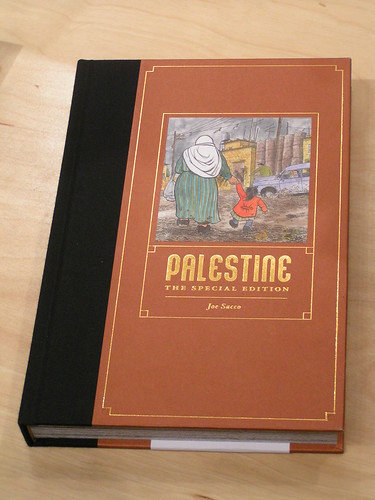
Now, the book that started it all, "Palestine," has been lovingly repackaged in a hardbound "Special Anniversary Edition."

The new collection comes complete with extended notes by Sacco, photos from his initial trip, early sketches, rejected pages and more, making it the graphic novel equivalent of a "Criteron Collection" release.

I recently talked to Sacco about "Palestine" and its influence. Here's what he had to say:

Q: How does it feel to be revisiting "Palestine" after all this time?

A: Well, you know, once you finish a book you kind of want to move away from it, not so much because you disown it, but because it seemed like a lot of work and you just creatively were in its grip for so long that it can be difficult to go back to it.

On the other hand, it was interesting to look at because so much of the way I work, the way I draw especially, has changed. It’s interesting to go back and see the energy I had in those days and in some ways the freedom I felt to explore what you could do with the idiom.

And of course now, inevitably, just because you get more experienced, you hone your craft, you know what you’re doing more, you’re more self-conscious, you kind of miss that abandon. I think there’s a certain abandon in the way I drew Palestine.

Q: Like an aloofness?

A: Yeah, that’s one way of defining it.

Q: I know you were talking about this in the introduction, but if you could just go over again why you decided to visit Israel and the occupied territories and turn your travels into a comic.

A: Well there were two main reasons. If I had to disentangle them -- and often these things are quite entangled for purposes of this conversation -- the two main reasons would be I was pretty much appalled by what was going on in the Palestinian occupied territories and I felt compelled to go and see for myself. In some ways that’s part of and is in tandem with this feeling that I’d been fed a lot of bullshit about what was going on in the region by the American media. Having studied journalism, I was plainly upset by the fact that I’d studied journalism, I thought I understood what objective journalism was all about, and then I began to realize that so-called objective journalism hadn’t shown me a damn thing. In fact, it had, as far as I'm concerned, misinformed me about what was going on. Or didn’t inform me, that’s probably the lightest way of putting it.

And so, having studied journalism I felt somehow betrayed by other journalists or other media outlets, because it’s not just the fault of journalists. That was another reason I was propelled to go. It’s the thing itself and the way the thing had been presented.
Q: In what way did your visit affect your initial perceptions?

A: Well, in that particular trip, and it doesn’t always happen, but in that trip my initial perceptions, my perceptions from afar, were re-enforced. What I thought I’d see, I saw. But of course, you’re seeing it in a very clear way and you’re seeing things you didn’t know you’d see necessarily, other parts of the puzzle, but ultimately what it led down to was what it was about before and when I got there was the brutality of the occupation.

Q: Now did you initially go with the idea of making it into a comic or was it more along the lines of “I just want to go and see for myself.”

A: It’s both. I wanted to go see for myself. I was compelled to do that. But I also didn’t like the idea of just going and being sort of a tourist in the occupied territories soaking up stuff with no real reason except to edify myself. That might be fine, but I thought I’ve already started this career — I wasn’t in high gear with the career, but I was already a cartoonist doing comic books -- and I thought well, I might as well make my trip useful. I thought when I went there I would pretty much thought of making it a travelouge of my experiences there. It would be autobiographical.

I knew that studying journalism I would want to talk to Palestinians there. I knew that would work its way into the book. It wasn’t going to be about me bumbling about. It was going to be other people's stories. I had a loose idea of what I was going to do, but when I went there I had no understanding ... I wasn’t 100 percent sure of what I was doing or whether I would be able to produce a book. Of course you go there without any experience and the fear is you’re not going to be up to the task of doing what you think you should be doing. That was a question to me.

Q: Was there, either during the trip or after when you started working on the comic, an aha moment for you where you thought "Hey I’m on the verge of something here. I could make a career out of this?"

A: No, strangely it was the opposite. There’s the creative part of you and fortunately, I let the creative part of me just go where it was going to go. You through away the bridle and let the horse run. But there was that other part of me that worries about eating and paying rent that was thinking “This is commercial suicide. I should just keep doing comics about rock and roll because I know about that stuff.” I was living in Berlin at the time and a lot of interesting things were happening there. Why not do that, that makes more sense from a commercial standpoint.

It was interesting to me, it wasn’t just like the philistine in me thinking. I wasn’t sure this was going to fly at all. There was no great "a-ha" moment becuase the comic was serialized and there were nine issues and each issue, if I remember right, was selling less than the one before it. So there was no a-ha, it was more like “OK, I’ve committed myself to doing this, it’s going to take a number of years to do, I’m going to finish it and that’s all there is to it. I’m just going to keep my eye on the ball." Because creatively I was enjoying it and I was sort of reliving the experience which was a good thing for me personally but I didn’t really think it was leading me anywhere commercially.

The "a-ha" moment would come when you feel others are responding to it. Critically it seemed to do really well, I had good comments from people who knew the region and all that, but if you don’t see readers reading it in the United States of America ultimately something has to sell for it to fly. If you want to make a living at it. If I was going to be an outsider artist all my life, which is fine, but that’s not who I am, I’d like to live just like anyone else would like to live.

Q: It’s funny you say that because it is your most well-known book and it did turn into a career for you so it’s interesting that you were so unsure that people would respond considering what it’s led to for you.

A: You know, what made "Palestine," I guess I’d have to call it a modest success and one that’s fine for me, and it’s done well, is the book on Bosnia. When I did the "Gorazde" book, I was at a low ebb for different reasons but I was almost about to give up cartooning completely. That book did well. It got reviewed in substantial mainstream markets. That book got a lot of attention. It was actually after that book was released that "Palestine" was collected into a single volume. That’s when "Palestine" began to do well, when it got into bookstores too. So actually it’s almost the success of the Bosnia stuff that led to the door opening for "Palestine," which was at that point being done for years.

And it’s true, I guess I’m more well known for "Palestine" on a certain level, but I’d say that has to do with the topic. That’s the reason.

Q: Recently Tom Spurgeon said something along the lines of publishers didn’t know what to do with your work or how to promote it. Do you feel that’s changed significantly? That the market has changed enough to support you doing these kinds of comics?

A: The market has changed immeasurably since I started doing "Palestine." Then I had no perception, no concept of myself in comics. I quite naively thought that based on what I’d done with "Palestine" I could get someone to sponsor my trip to Bosnia. That was laughable because even though people might like what I did with the "Palestine" comic, at that point it hadn’t been collected into a book and there was no proof that it had sold. I basically got a lot of nos and had to self-finance the trip to Bosnia too.

So that was two major trips I had to self-finance and that’s why I was at the end of my rope. But because the "Gorzade" book did well and then the "Palestine" book did well, and I started getting a lot more attention from people like yourself. Suddenly doors started to open. Editors were more interested and to make a long story short I’m at a point now where if I really wanted to travel somewhere and do a story I would just have to call my agent and mention it and see if she thinks anyone will buy it.

Editors are much more receptive. Often they seek me out. I think partly that has to do with the fact that comics it seems in the last few years, and it’s not just because of my work, comics have just achieved a critical mass. Of course there were great comics before, but for some reason it just happened now.

Also, editors are younger. and that makes a difference. when you’re dealing with someone who’s in his 60s, unless he’s up to date or willing to try something new, they would just sort of look at you and think “Nah, I don’t think so.” It’s really changed a lot.

Q: What do you feel is the general reaction towards "Palestine?" How do you feel it is regarded both in the ensuing years and initially? And also, what are some of the more interesting reactions you’ve gotten from people?

A: I think generally "Palestine" has been pretty well-regarded. I think clearly it’s not a unobjective piece of work, but that’s clear, I’m not trying to pretend otherwise. But I do think, as I said in the intro, I think it’s an honest piece of work.

So to me the best response, the ones I enjoy the most are from people who’ve spent time in the region and say my experiences really resonate with them because they remind them of their own. There have been occasional attacks on it. but the great thing about having done it the way I did it, despite the fact that it was disheartening not to have any attention, on the other hand, it was under the radar, which allowed me to do it without worrying about critical response. I was maybe less steeled for that than I am now.

Q: Are you more concerned about a critical response now?

A: No, just as much as anyone. I’m older now, a bit more mature, I could probably handle it better.

Q: I didn’t mean to the extent that you would change something in the book but more that you were aware of it moreso than before.

A: I think I’m just more confident in my work now than I was during "Palestine."

Q: I wanted to ask you how the work evolved as you wrote it, because the tone changes a lot. I think that’s one of the good things about the book, but it starts out very self-effacing and then takes a much darker tone as you get into Gaza.

A: Well, the thing about the West Bank episodes is that they are self-contained chapters. When I got to Gaza I actually fell in with two or three people that end up being characters in the book. and I think that’s where the emphasis shifts. And I think I was sort of overwhelmed and stupified by what I saw in Gaza that Gaza itself becomes a character in the book and I have to recede. It might have almost been a subconscious decision with me but clearly my self-effacement is very secondary to the grimness of the situation. I’m not sure it was something I thought out. I knew the Gaza chapters would come at the end of my book because that was the chronology of my trip. Not that the book was entirely chronological, but that’s how it turned out. And I think it serves the book, sort of bumbling, funny to purely grim.

Q: You also make a lot of different stylistic choices as the book goes on, for example in “Moderate Pressure Part 2” you slowly divide into smaller and smaller panels or you have pages with lots of text. You mix it up a lot and I was wondering how conscious that was and in a general sense how you arrived at those sorts of choices.

A: Well some of those choices were just the maturing of an artist. One of the interesting things about the "Palestine" book is I think I matured as an artist in that period. It’s funny because in some ways it’s not a consistent book as far as the drawings go. Initially if you look at the first few pages, they’re very cartoony. If you look at the last few pages, they’re still cartoony but they’re much more representational. I purposely tried to tone down the cartooniness because it didn’t seem appropriate to the kind of journalistic story I was telling. It took effort, because I was never trained to draw. That’s something I’ve had to push myself toward.

That was a very conscious decision. Another conscious decision was to lose the wild panels and angles. Now some of those are in the later part of the book, but especially in the beginning, I’m much freer and looser with how I'm showing things. And I’m sorry to say that a lot of that had to do with the fact that I wanted to keep myself interested in the drawing. One of the hardest things to do is to draw the same thing over and over again at a certain angle, even if it’s necessary to tell your story. I’ve learned to do that. It doesn’t necessarily make for a splashy looking page, but it keeps the story going. I’ve learned maybe not to arrest the reader at the wrong time with a fancy drawing.

One thing I do like about the book and that I’ve continued to use is the use of very large two page spreads or long big panels detailing a lot of things going on. That give a very broad perspective of what a place looks like. A lot of that came from children’s books I read when I was a kid, these history book that would have castles of the middle ages with all these people walking around.

Now I’d say my art, I think I get better. I just draw better. I’m definitely at a plateau now where I know when to rein in certain tendencies I have. It doesn’t make for as spectacular a book as "Palestine," but it makes for one that reads a bit more smoothly.

Q: Are you still in touch with any of the people you met during your initial travel?

A: No, not during my initial travel. I sent books to five or seven people and never received a reply. But you know you have to send those books through Israel so I don’t ...
Q: They may never have gotten them.

A: I don’t know, I can’t say. When I was there recently I tried to look some people up but I just couldn’t find them.

Q: I was curious whatever happened to Sameh.

A: I was curious too. When I was lost in Jabalia Camp I really tried to find him. Maybe on some other trip.

Q: You were back again recently?

A: I’ve been back about five times since the book came out. Most recently I’m working on a book about Gaza based on three trips I took there. That was 2003 was the last trip I took and a lot’s happened since then.

Q: What can comics do for journalism that photos or pure prose can’t? What are the benefits of doing a journalistic story in comics?

A: There’s a number of them. I think comics are a very subversive sort of medium. I think people are attracted by images, they’re attracted by the pictures. They also think “Oh, it’s comics, it’s going to be easy.” A reader’s going to say "I’ve never read a book about this in my life, but it looks like I can get into this." They get sucked into it and then the story becomes the main thing and they’re getting a lot of information. I think that easily rivals a documentary series.

I think a comic because of repeated images also can create an atmosphere of a place. It’s repeated images so there are certain things going on in the background that you don’t have to mention over and over again. If you’re writing about how much graffiti was on the wall in prose, you write it once, you don’t write it every paragraph. Whereas in comics, it can be in the background every panel so it sort of sinks into the reader’s consciousness.

The other thing I think you can do with comics is take people back and forward through time. You can be in the present, you can switch to the past, and because of the way you draw, it seems seamless, with no actors acting out the way they do sometimes with documentaries that makes you kind of wince.

Q: I definitely agree with you about place setting, because one of the things I got out of "Gorazde" was a sense of what that place was like.

A: Thank you. That was very important to me, because I remember reading John Byrne’s article, he’s a New York Times correspondent, from Gorazde when he actually walked across those fountains and spent a week there in 1993. And they were very compelling and very evocative but on the other hand I had no clue what the place looked like. When I go there I had nothing that I could say this is what the place looks like. When I got there there were tall apartment buildings and wow this is a town. From reading the articles I had no clue whether it was a village with little houses or what. So to me, to make something real, you can do it with drawings.

Q: What lessons did you take away from "Palestine" as an artist?

A: Many things. A very specific thing is I wouldn’t do that long text piece and just had illustrations like you mentioned. However, the main thing I learned is that I could do this. That at least to my satisfaction I was able to accomplish something. That gave me the confidence to go to Bosnia. That’s really the main thing. The other thing is you learn over the course of three years, drawing day in, day out, your drawings get better. That’s the hope.
Q: As I’m talking to you the big news this week has been about the meeting in Annapolis, so what do you make of the current Mideast situation? Is it better or worse than the situation you portray in Palestine.

A: I think it’s much worse. Since I was there for that first trip there was the second infantada with great amounts of violence. The whole thing with Annapolis, I’m not the first person to say this but at first they made it sound like something substantial was going to come from it, and now they just met to say they’ll be meeting later. It seems ridiculous. Everyone’s putting themselves on the line for nothing. I don’t see anything coming from this. I’m pessimistic.

Q: If you could look into your crystal ball, what do you see for the future of Israel and Palestine?

A: If things continue the way they’re going, if they’re not arrested, if my crystal ball could go 20-30 years down the road, I don’t see a very good outcome for this for either the Israelis or the Palestinians. I think one or the other is going to be seriously hurt when it comes down to it. I fear for the Israelis actually and I fear for the Palestinians. the worst case scenarios are that Israelis lose what they have or Palestinians are completely evicted from the land. Either of those events are possible. They better figure it out sooner rather than later is what I’m saying. The longer it goes on, the more entrenched the problem’s going to become. It’s already one of the longest running problems in the history of the world.

Q: Do you see anything that gives you hope?

A: The only thing that gives me cause for hope is that individuals on both sides and probably the majority, really want to settle the problem. Most people are pretty sensible and just want to have an ordinary life and want to move on. Things like dignity and justice are very important, no doubt about it, but there’s a need to live an average life that people have and the hope is that there will be enough pressure from below to make the leaders figure it out. It seems like the problem is some of the things that have happened were made specifically to make the problem intractable. There’s no other explanation as far as I’m concerned for the settlements. Putting 500,000 people and I’m including Jerusalem, which is often excluded from conversations like this, but putting people in an occupied territory is not an easy thing to undo. And that was the thinking behind it, to make it impossible to go back. They’ve done a good job of that. It’s unfortunate. Unless that is significantly reversed, I don’t know what else to say about it. You’re really leading to endless conflict.
Q: Part of the reason I ask that question is in Palestine, and I hesitate to use the word fatalistic, but there is a sense of an overwhelming problem that Americans are a) not aware of and b) so divisive that — there’s very much a sense of being overwhelmed by the time you reach the end of the book. I mean that as a compliment (laughter).

A: That’s interesting. I was only putting down what I felt and what I saw. I think it’s unfortunate that — it seems that America would be a friend to Israel by saying now is the time to deal with the situation. Under every American administration, but particularly under this one, they’ve allowed Israel to sort of just ...

Q: ... do whatever they want?

A: Yeah, that’s basically it. I don’t think that’s good for Israel. Actually there are saner voices in Israel that keep saying we can’t have the Americans allowing us to continue this.

Q: Again, there’s that sequence at the end of Gaza strip, where you leave this wrenching sequence, and the guy in the car has yet another story. So again, there’s the sense of this enormous problem. And at the end you ask what happens, what comes next?

A: Well, that was it. You see some kid being humiliated like that, and you put yourself in that person’s shoes and you think this could turn out a lot of ways that might not be for the best. And then you wonder why people do what they do? In some cases you see a direct link to what they’ve lived and what they’ve seen and what they do. And that was an open-ended question that I wanted to leave because that’s how I felt. How long are you going to keep a lid on this? You can't do this to people continually. One generation gets battered down and then rises and then the next generation gets battered down and rises but at some point people break. They either break or they fight. It’s one or the other.
Q: What do you think the influence of "Palestine" has been, especially within comic circles. It seemed to me when the book came out and also "Gorazde" years later, it won a lot of critical acclaim, but when I was getting ready to interview you I was trying to think of other cartoonists that were trying journalism, but I couldn’t think of any. What influence do you think you’ve had?

A: That’s a question for my many future biographers. I’m not sure what influence I’ve had. I’ve been contacted by cartoonists who’ve said they’d like to do something like this. I think other people have done this sort of thing. There are some French cartoonists who have. Even Art Spiegelman was once an editor at Details magazine and pretty much his approach was to send people out on journalistic assignments.

Some of those were lighter than others, but the idea was still to send someone out to report. I don’t know if that’s related to me and I don’t think an artist should think too much about that sort of thing. I’ve always thought of myself as a little anomalous. I see other cartoonists that are much more influential stylistically on others. I don’t see much of me in most of my peers. But I do know that there are some younger cartoonists who talk about wanting to do something like this. They say they’re inspired by me. And I’m glad for that, but any influence I’ve had I don’t see it yet.

I don’t see myself as the granddaddy of anything. And I don’t want to consider myself that. You start to ossify when you think of yourself as that (laughs). I think the door is open to this sort of thing.

Q: Would you like to see more people try their hand at this sort of thing?

A: Yeah, comics are so well suited for this sort of thing. There’s a Canadian cartoonists working on a book about mining. Canadian mining comics or something.

Q: What are you proudest of about "Palestine?"

A: The sequence in Gaza, and I’m not sure I can ever duplicate it or do as good a job, there’s sequence in Gaza where I’m with Sameh and we’re just walking through the camp. I feel like I created a mood and atmosphere there that I just allowed myself to do. I got my own experience down properly. That’s probably what I’m proudest of.

I’m proud of the book as a whole. Of course I am. But then again, I wnat to move on and I don’t want to be just known as the guy who did "Palestine." I don’t want to be creatively trapped by it either.

Q: Tell me about this new book you’re working on.

A: I won’t tell you too much about it. I’m more than 2/3 of the way done. It’s a very long book. I’m up to page 230 now as we speak. It’s Gaza and some time I spent in southern -- Khan Yunis and Rasah. I spent time there in 2003 but it’s mainly a book of history. It’s a book about what happened in Gaza during Israel’s very short occupation of the Gaza strip in the 1956 war. So mainly I was just speaking to old people.
Q: Who’s going to be publishing that?

A: Metropolitan. They’re a division of Holt. They’ve never done a comic before, so this is something new for them.

Q: When will this be coming out?

A: Well I won’t be finished it until late next year, so my guess is 2009. And the way I’m going, I’ve got a lot to do.

Labels: , ,

Wednesday, July 25, 2007

Graphic Lit: Five Fantagraphics books


The small-press, art-driven publisher Fantagraphics has been on a roll lately, releasing a number of smart-looking, compelling books in a short space of time. Here’s a quick rundown of some of the more notable titles:

“Things Just Get Away From You”
by Walt Holcombe, 212 pages, $24.95.

Holcombe is one of those artists who regrettably slipped through the cracks in the 1990s, a variety of economic and cultural factors preventing him from garnering the sales and acclaim his work deserved. One hopes this collection from that period will result in a resurgence of interest.

Combining big-nosed, rubbery cartooning with arch, sometimes affected dialogue (“I’ve gawked into the maelstrom and for my trouble I get me a poke in the eye.”), Holcombe’s tales see-saw between grim fatalism and playful absurdity, often within the same panel.

“Things” is filled with sad-sack characters whose restlessness and selfishness keep them from holding onto love and happiness.

That sounds dour, but Holcombe’s universe is too unique and, in the end, too charming, not to visit.

“Misery Loves Comedy”
by Ivan Brunetti, 180 pages, $24.95.

When the first issue of Brunetti’s intermittent series “Schizo” saw print way back in 1995, the effect was something akin to being punched in the stomach really, really hard.

Full of bile, uncompromisingly scathing toward anything having to do with a) mankind or b) himself, Brunetti served up the blackest humor, with no subject matter deemed too taboo to wring a tasteless joke out of.

“Misery Loves Comedy” collects the first three seminal issues of “Schizo” along with an assorted collection of other gag strips, most of which cannot be described, let alone repeated verbatim, in a family newspaper.

The book is far from some sophomoric attempt to push the envelope for no good reason, however.

Brunetti’s attempts to deal with his crippling self-hatred and depression on the comics page makes for fascinating if highly unsettling reading (one panel shows hundreds of Brunetti clones killing and maiming one another in a variety of horrific ways).

Basically, Brunetti is too talented a cartoonist to be easily dismissed. To read “Misery” is to watch an artist use his creative abilities to guide him through a black depression and (judging by the end of the book) come out the other side stronger and more focused.

If you’re not the sort of person who’s easily offended, I highly recommend it.

“Percy Gloom”
by Cathy Malkasian, 180 pages, $18.95.

Usually when I hear the description “a fairy tale for adults,” all sorts of warning signs go off in my head.

“Percy Gloom,” however, thankfully manages to avoid the sort of twee sentimentality that readily applies to most books slapped with that label.

Created by the director of “The Wild Thornberrys Movie,” “Gloom” tells of a nebbishy little man whose sole goal is to become a “cautionary writer” for the Safely-Now Corp. It goes without saying that all sorts of unexpected obstacles stand in his way, and in the end Percy discovers that in life one can be too cautious.

Overall it’s a stunning debut, filled with striking, smart ruminations on the brevity of life and happiness and the sweetness of both.

“House”
by Josh Simmons, 80 pages, $12.95.

Three young hikers explore an enormous, desolate mansion when irrevocable tragedy strikes in this short, wordless horror story that doesn’t pull punches.

Simmons begins the book with large, open panels filled with white space that slowly become smaller and blacker as the story progresses.

The net effect is that of increasing claustrophobia, perfectly mirroring the characters’ ever-increasing despair. It’s a sharp, evocative little tale and easily the best work Simmons has produced thus far.

“The Three Paradoxes”
by Paul Hornschemeier, 80 pages, $14.95.

Autobiography and formalism merge in this slim volume that sees Hornschemeier at his parents’ home, reflecting upon his childhood.

The book’s art style changes frequently throughout, as the author remembers past slights, imagines other people’s wounds and even delves into Zeno’s philosophy (hence the book’s title).

“Paradoxes” isn’t perfect — the whole “artist writing a story about how he can’t write a story” has been done better countless times before — but the book is grounded in a sincere humanism as it ponders the transitory nature of life and how frightening that aspect can be.

Perhaps “Paradoxes” is best viewed then as a transitory work in itself, one more rung on Hornschemeier’s ladder as he slowly reaches toward what will surely be a truly seminal work. 

Copyright The Patriot-News, 2007

Labels: ,