Thursday, March 12, 2009

An interview with Ed Brubaker

Below is an interview I did with writer Ed Brubaker a few months ago when his new series Incognito debuted. Originally this was going to run as part of my column but, well, que sera sera. Here's the full interview:


Q: So tell me about Incognito.


A: Incognito is an idea I’ve been mulling over since we were wrapping up Sleeper. I often try to think of the inverse of an idea to see what would be interesting — if this idea is interesting to explore in one direction would it be interesting to explore it in the other? Look at a story like The Shield, where you’ve got a corrupt cop who’s trying to save his soul. What if you flip that to the other side where it’s a mobster instead of a cop? I think of things like that sometimes and try to see if there’s a story in there.

Sleeper’s about a good person who for his government goes undercover as a bad guy and slowly loses whatever moral compass he had and starts to realize that the bad guys and the good guys aren’t that different in the ways that they act. And maybe doing bad things for the right reason is just as bad as doing bad things for the wrong reason. There’s a lot of moral gray areas to explore there, so I was thinking "What if you did the opposite, what if there was a bad person somehow forced into a situation where they actually either had to or ended up doing good things, but they’re someone who has no moral compass, who looks down at humanity and ends up somehow through circumstance being forced to live among them and develop sympathy for them perhaps?"

That’s where Incognito grew out of, trying to figure out, is there a story in that character exploration? Then I started thinking of it in terms of a noir story and suddenly I was "Oh, what if it’s a super villain living in witness protection," and everything started to come together from there. All my love of old pulp characters like Doc Savage and the Shadow started to come out. The idea of trying to do a story that’s sort of a mixture between the modern superhero and a '50s noir story really started to appeal to me. I started thinking “What if the pulps had never stopped? What if instead of crime stories and noir, the crime pulp stuff was mashed in together with Doc Savage and the Shadow and Operator Number Five?” What if they made noir-esque stories with these characters? Everything started building from that.

Q: Tell me a little bit about the main character and how you see him. He comes across as not the most likable character, and that’s always a little tricky because you want the audience to have sympathy for him.

A: He’s definitely an anti-hero. That’s the story. It’s the journey of a bad guy. He’s an Eastwood type. It’s that kind of character, Eastwood in Fistful of Dollars or somebody who is clearly an outlaw. And yet we’ll start to see there’s something about this person. I think by the end of the first issue you get an idea that this guy isn’t just this anti-hero who looks down on everybody and feels trapped by this thing. You see some of the wounds this guy carries and how he became who he is. He becomes a more human character even by the end of the first issue, even though he does retain that hardened edge of a guy who was raised on the wrong side. I guess if you’re raised on it, it doesn’t feel like the wrong side.

Zach and his brother Xander were raised -- they’re twin brothers -- and they were taken from a state adoption home and have no memory of it. They’re earliest memories are of being experimented on by this mad scientist guy who was in this evil organization known as the Black Death. They were taking orphan kids and doing science experiments on them to try to turn them into super villains, basically. He was a twin and he and his twin brother were major enforcers for this evil organization and at some point about three or four years ago something happened to his brother and he ended up turning on the people he worked for. Now he’s living in witness protection, but everybody thinks he’s dead. And he’s on drugs that make him a normal person. They shut down all of the enhancements that he’s been given.

Q: That sounds a lot like some of the characters and themes you’ve been exploring in your other books like Criminal. Certainly the idea of family, like the Lawless brothers in Criminal and even the Cap/Bucky relationship in Captain America.

A: There’s some truth to that. We all have a few themes we explore over and over again as writers, whether you consciously know it or not.

One of the main things in this for me came out as an accident in that it occurred to me that the main character was a twin when I was thinking about the themes of the book, when I was fleshing out the ideas of the book early on. The word Incognito has so many different meanings. You’re doing a story about people who put on costumes and run around but doing it in a sort of noir way -- well, all good noir is at heart character studies with a plot taking place around them. You really build your whole story from the character.

So I thought “Who is this character” and it occurred to me that a lot of what the story is about is a guy who doesn’t exactly know what his identity is. He’s living a lie. The person that he truly is taking drugs and is living in this suburban Anytown, USA, kind of place working an office job and pretending to be someone he isn’t. He’s completely incognito and yet he puts on a mask and feels like this is who he is. Or maybe it isn’t. There’s so much about identity.

And it occurred to me “why does this guy go into witness protection” and then suddenly the whole twin thing came up. Identical twins have so much of their identity sometimes wrapped up in their twin. A lot of time they’re really close friends and have mental connections and things like that. So the idea of a twin separated from his brother and everyone thinks he’s dead and he’s living this new life for the first time on his own, but everything about it is a lie. So it really gets to the heart of what the story’s about in a lot of ways.

Q: It’s interesting because your description also fits Clark Kent.

A: Does it though? He was raised to be Clark Kent. Going into witness protection is a lot different. (laughter)

Q: That’s true, but —

A: "As a baby, Superman killed many, many people, but he was able to testify against Kryptonians and moved to witness protection in Kansas to be raised by an elderly family."

Q: That’s my recollection of the story.

A: That’s actually a pretty good story. If I ever get my hands on Superman ...

Q: One of those Elseworlds tales —

A: Even as a baby he had full adult intelligence. That’s a creepy story though. I like that.

Q: But it does sound like you’re playing off the kind of wish fulfillment that a lot of superheroes provide. Especially in that initial 2-page preview, where the lead is saying “I’m better than all the other people I’m surrounded by.”

A: Yeah, it is kind of the flip side of Superman/Clark Kent sitting there and thinking “nobody knows.” This is him sitting there and thinking “Nobody knows I could kill all of you and not care.”

Q: Are you consciously going to be playing off of the traditional superhero tropes in that aspect?

A: I don’t think so. I never consciously set out to do a parody of anything.

Q: I didn’t necessarily mean a parody —

A: No, I know what you meant. But I don’t think I’m consciously trying to reference any other superhero comics at least. There’s little nods here and there to the pulps because when you do a story like this and you’re creating the whole thing from the ground up, you have to do a little bit of world-building. My world-building was creating these pulp-hero characters from the '30s and '40s and they’re not really important to the story at all, they’re just background elements to the world. You may not ever see them in the same way there’s tons of elements in Criminal that nobody ever actually sees. We referenced Sebastian Hyde a number of times before anyone actually saw him.

With Sleeper we did that thing where the characters all told their secret origins in third person which was a little play on the origin stories of characters and a little play on the way origin stories used to be told. I don’t think that’s what I’m doing. Who knows? It’s hard to tell when you’re in the midst of it. I’m deep into writing this project now. All I can think of is the character and the shit he’s getting into. Obviously the point of the thing is to explore the gray area between good and evil from the other point of view. We always see that side of it, the good person doing bad things and how that affects you; on some level this is approaching that.

Q: You talk about taking part of things from the pulps and noir and superhero comics. What things are you consciously taking? Are there any genre tropes you’re taking and how do you roll them up and keep them from bumping into each other, because they’re different genres, or at least perceived as such.

A: It’s kind of apocalyptic noir in this weird way. Noir isn’t really a genre — People think of it as a genre, but the people who think of it as that, when they start to tell you what movies that would fit into that don’t realize how elastic that actually is.

A noir story, if there are rules to it, the main rule seems to be whoever your main character is, nothing good is going to happen to him. (laughs) And at the end of the story he may be dead. If he’s narrating, he may be narrating on his deathbed. It’s more of the way a story is told as opposed to what the story is. Many things that a lot of people consider noir could also be considered straight crime stories. A lot of people consider the Parker novels to be noir, but I just think of them as heist novels. Parker tends to live through all of them and there isn’t a lot of tragedy involved in that process.

I think instinctively I’ve always brought that air of tragic noir element to whatever I'm doing. I’m trying to subvert some of the principles of that genre a little bit by doing this. It’s kind of an experiment to take pulp and make up sort of an evolution of where these pulp styled characters would have gone and how they would have affected a world of also try to tell it through this really character-driven noir story. So it is a little bit of an experiment, but I really like the elements of something like Doc Savage; I love these apocalyptic literature of pulp fiction with these characters who were just sort of weird, crazy, vicious characters who were planning to destroy the world, and you had a guy like Doc Savage who would take out whole organizations and whoever would survive they would take them back to their institute and carve out pieces of their brain so they wouldn’t be bad guys anymore.

There was weird stuff going on in those pulp stories that comics sort of evolved from. As comics started being more and more for kids a lot of that eccentric bizarre early atomic-age stuff just fell by the waste side. That’s the kind of stuff I’m tapping into a little bit with Incognito. Just using that hard, crazy science edge to some of this world. Not as if I’m the first person by any means to explore the pulp roots of what superhero comics grew out of. Alan Moore started a whole line of stuff. But they weren’t the first either. We wouldn’t even have Batman if not for the Shadow.

Q: I talked to you back when Criminal first came out and I remember you saying how with Sleeper, because it was aimed at more traditional comic book readers, you were able to be a lot more experimental in your layouts and design. And with Criminal you wanted it to be very basic so that anyone could pick it up. What about with Incognito?

A: I think it’s mostly pretty straightforward. With every project it seems like Sean starts to experiment a little bit with the way he tells a story or structures a page. With this one, my favorite art from him, maybe ever, is the stuff for Incognito because I love the way he’s doing these no-panel borders, using the gutter space as negative space and hard clean balloons for the word balloons. Everything’s very mechanical except for the stuff that’s hand drawn by him.

Sleeper — he’ll probably do a story like that again, with that kind of experimental storytelling, but I’ve seen what he’s doing now with these odd panels that have these full bleeds. He’s doing this thing where he’ll make certain panels pop so they’ll bleed to the edge of the page.
Q: Of course, Criminal has changed. Both of you have gotten a little more experimental.

A: Yeah, but we’re still basically sticking to a three-tier grid. I can’t remember who said it, but if you can’t tell a story on a three tier grid you can’t tell a story. The first advice I remember reading in a book about experimental layout when everybody was trying to do weird angle panels and imitate Neal Adams with all of his crazy storytelling stuff he did and somebody pointed out that before Neal Adams ever tried that he made sure he could tell a story in 6-9 panels per page. Learn the rules before you break them.

Q: Not to take away from any of the other artists you’ve collaborated with, but this is the third book you and Phillips have worked on and you seem to click together well. What do you think it is that allows you to work together so well?

A: I don’t know. We’re just on the same page about the kind of comics we want to do. I really feel like a lot of what I do pacing wise really fits most of my scripts if you look at any of them have as much description of facial expression and what the character is feeling as it does with "in the background there’s this and this." All my stuff wouldn’t wouldn’t work at all if I didn’t have artists that can really generate empathy from the readers for the characters. Sean just does that really well. We love a lot of the same comics and aspire to do things on the same levels as the books we really dug. A lot of times we’re playing to each other. I feel like I’m writing this stuff to some degree for Sean because he’s the first person that reads anything I write for anything I own.
Q: Is this going to be an open-ended story? Do you have a definitive end in mind? Or could this go on?

A: It’ll depend. I know the end of this story, I’ve got the last scene written already. It came to me early on. It’s definitely left in such a way that if someone were to want to, we could revisit this character or other characters in this world, depending on if I end up sticking with that scene.The plan right now is once we finish this to go back and do more Criminal. We’re having a lot of fun. With Criminal especially built up a pretty loyal, sizable audience of people who are clearly following us over to Incognito. And hopefully we’ll pick up some more from Incognito. As long as people keep buying comics by us in enough quantities that we can afford to keep doing it, Sean and I will put out as many of them a year as we can.

Q: I was going to ask you how Criminal was doing.

A: It’s doing really well actually. We’re one of the more stable books on the market apparently. We’ve been doing about 18,000 an issue. That’s advance orders. I think we’re doing close to 19,000 on final sales. That’s better than most books like that. I always want to reach more people and I feel like it’s still under-performing cause I still hear from people all the time whose stores buy three copies and sell out the first day so I always know they could be selling at least a few more. It’s better than almost everything Vertigo publishes.

Q: I was going to say.

A: Yeah, other than Fables. From my side, once we relaunched with the new format and I think after issue two, the orders for issue three actually went up and in issue four the orders were higher than one even. And we’ve just stayed at that level. One issue I think was 30 copies less. It’s insane to have a book where the numbers are the same every month.

Q: What about the trades?

A: They’re doing really well too. We’ve sent the first one back for a second printing and we’re pretty close to selling out the first print run of the second trade. I’m just waiting to get some statements. but we’re moving really good numbers, and mostly through comic stores. We’re not really doing huge bookstore push because I handle all that stuff myself. Also we’re in print in five or six other countries and our French publisher has gone back to print with the first book. We’re coming out all over the world with this stuff. The more books come out the more they seem to feed each other. Every day I hear from more and more people who are just getting turned onto it, so it just seems kind of crazy, for two years and only 17 issues.

Q: How many issues is Incognito?

A: Five issues and then we’re back to Criminal. We’re doing the next Lawless story after that. Incognito’s just five issues. We’ll probably do more of it. We’ll see how we like doing it the further in we get. So far I like it, which is surprising, because after Sleeper I thought "Let’s just do crime stories and not deal with any of the super-powered stuff at all." But it’s a lot of fun to be back doing something like this with Sean where we get to flex some different muscles and have some fun within that genre. I like working in comics you can do a story like that and a large part of your audience goes into it knowing what a super villain is.

Q: Working for someone like Marvel or DC you’re under these creative restrictions as far as what you can or can’t do with the character. In your case I”m not sure that’s true, because they always say they can’t kill the character and you did.

A: I’ve gotten really lucky with getting away with murder, literally, on books but also I haven’t slammed up against a lot of restrictions. Things you can or can’t say I get a lot, in terms of from month to month it seems to change. There’s never any hard or fast rule. You can say "damn" in a book but you can’t say "damn"19 times on a page. Weird things like that.

I don’t think I could do the work for hire stuff if I wasn’t also doing original work. I think they feed each other at this point for me. I went a few years only doing work for hire stuff when I first started out at Marvel before Criminal. It just seemed like I was going to lose my mind if I didn’t start doing some work that I actually had a stake in and felt like was important to me. I have a big stake in Captain America and Daredevil. They are important to me but it’s a whole different thing when you create all of it from start to finish. You own it and it’s your universe. It’s not everybody else’s too.

Q: You don’t have to worry about tying it into Civil War.

A: But even that stuff, if you take those jobs at Marvel, you can’t complain when somebody says "Oh we want you to tie into such and such." I’ve been really lucky. People think that happens more than it actually does. I have editors who say "Hey our book needs a boost, tie it into such and such a thing." I’ve been on that end at DC. I don’t think I’ve ever been on that end at Marvel but I’m sure there are people who have been.

You’re trying to tell the best story with someone else’s character and I lie to myself and make myself believe I own the Captain America part of the Marvel Universe other than Brian being able to use him in Avengers. But during Civil War Cap was in every third book and usually getting beaten up by the main characters. He probably got captured like nine times during Civil War. I’m the only one who didn’t have him get captured.

You lie to yourself and tell yourself it’s your character while you’re writing it. You have to otherwise you’re not going to do a good job and give the readers their money’s worth. which is what your job is to do. Make people want to keep reading these characters. That’s a great fucking job. It beats flipping burgers, which I’ve done. It beats any job I’ve ever had because it’s still creatively fulfilling. But doing your own stuff is even more fulfilling. (laughs)

I like both. I love Captain America. Ever since I was a little kid I’ve had these ideas that I would grow up and work on Captain America. I probably went a good decade or so without ever thinking about it, but the moment I got that phone call from Brian saying "Hey is there anything you want to do? I know you’re exclusive is ending soon," and Joe called me the next day to offer me Captain America. There was no way I was saying no. It’s pretty cool. It’s the same way I would work on Doc Savage or the Shadow if Marvel had them. I find if I go a full month without writing something that I’m doing — all the stuff is intended to be read and enjoyed by people but Incognito and Criminal, as long as I’m doing something that Sean wants to draw and that I’m really into. Bad Night is one of the best things I think I’ve ever written.

Q: I have to say, I thought that last issue was supurb.

A: Thanks. I was trying to do one of those James M. Cain style things. Jason Star did a book called Twisted City that has the best last scene in a crime story that totally changed everything about the main character in his last moment. I didn’t go for that.

It’s interesting. I do read the odd review and I noticed until issue four’s reviews, almost all people online reviewers were thinking that Jake was having conversations with the Frank Kafka character throughout the whole story. If you read it, you can see that’s not actually happening at all. In the first three parts of the story, up until the very last panel of part three, he never acknowledges Frank’s presence at all. As a reader you can think he’s just imagining what his comic book character would say or do because he doesn’t interact with him. It’s almost like it’s a voice inside of his head, which is what you’re supposed to think. And then you realize it is a real voice inside his head.

That was one of my favorite things I’ve ever worked on and one of the hardest things to write too. There’s not a single scene in there that isn’t important to the big conclusion. Even the first line of narration about the house burning down across the street comes back around. Everything comes back around. I feel really lucky to have a platform to do stories like that. The minute that sales started feeling stable, that sense of “Oh this is going to go away someday,” went away. I started to feel like we have a fan base that is actually following what we’re doing. I was always worried during the first 10 issues cause sales would fluctuate where it would seem like we were doing really good and then the next issue orders would be down 2,000. I knew we were being underordered. I didn’t think it was a bunch of "trade waiters" cause I kept hearing from people who could find part five of a five part story. I think we stabilized 3,000 higher than we’d been selling on the last four issues of the previous run. I can’t believe the same stores are ordering the exact same number every time. But maybe.

Q: I suppose in these times retailers can’t afford to take chances on extra copies of anything.

A: That’s why I’m really thrilled Incognito did as well as it did. It didn’t do as well as I initially thought when we first announced it and everyone flipped out. But that was a week before the economy started to tank completely. Or at least publicly tank. Bad time to be launching a new book. I keep reminding people not to flip out too much about the whole economy thing because: a) that will just make it worse and b) even during the Great Depression 25 percent of the country was still working. Don’t automatically assume you’re going to be in the other 25 percent.

Q: Right. It’s just in the newspaper industry.

A: (laughs) Right. You guys need to get a bailout together. The problem is those stupid news media conglomerates that seem to think you’re supposed to make a profit on journalism. Journalism is supposed to be a break even thing at best.

Labels: , ,

Wednesday, December 31, 2008

Graphic Lit: Best comics of 2008

Readers were rewarded with a wealth of stellar comics this year. There were so many good books, in fact, that attempting to group them in some sort of hierarchy could be a bit of a mug’s game.

Not that it’s going to stop me. As before, I thought I’d trot out what I hope will be my annual awards list, tentatively called “The Moxies.” (What? It was my nickname in college.)

Here then, organized into completely arbitrary categories in order for me to include as much good work as possible, are my picks for the best comics of 2008.

Best Original Graphic Novel: “What It Is” by Lynda Barry. This revealing and fearlessly original work deserves as much attention and accolades as it can get.

Runners-up: “Tamara Drewe” by Posey Simmonds, “The Amazing Remarkable Monsieur Leotard,” by Eddie Campbell, “Three Shadows” by Cyril Pedrosa, “Bottomless Belly Button” by Dash Shaw.

Best Debut: “Skyscrapers of the Midwest” by Josh Cotter. New cartoonists shouldn’t be able to create works so assured and emotionally devastating right out of the gate.

Runner-up: “Swallow Me Whole” by Nate Powell.

Best Collection of Previously Published Material: “Willie & Joe” by Bill Mauldin. Fantagraphics’ massive collection of Mauldin’s WWII work gives new generations the chance to experience it.

Runners-up: “The Explainers” by Jules Feiffer, “Breakdowns” by Art Spiegelman, “Where Demented Wented: The Art and Comics of Rory Hayes,” “Jamilti and Other Stories” by Rutu Modan.

Best memoir: “Little Nothings: the Curse of the Umbrella” by Lewis Trondheim. Master Trondheim once again shows how it’s done, this time providing a bit of navel-gazing that never becomes solipsistic.

Runners-up: “Paul Goes Fishing” by Michel Rabagliati, “Haunted” by Philippe Dupuy.

Best European Book: “Alan’s War” by Emmanuel Guibert. Guibert uses his friend’s ruminations to provide a unique look at WWII.

Runners-up: “The Rabbi’s Cat Vol. 2” by Joann Sfar, “Aya of Yop City” by Marguerite Abouet and Clement Oubrerie.

Best Manga: “Disappearance Diary” by Hideo Azuma. A chronicle of homelessness and alcoholism that refuses to be gloomy, “Diary” is perhaps the cutest story about despair you’ll ever read.

Runners-up: “Dororo” by Osamu Tezuka, “Cat-Eyed Boy” by Kazuo Umezu, “Red-Colored Elegy” by Seiichi Hayashi, “Good-Bye” by Yoshihiro Tatsumi.

Best General Nonfiction Book: “Burma Chronicles” by Guy Delisle. Delisle chronicles his time spent in a far-off, oppressive country with enormous good humor and insight.

Best New Series: “Love and Rockets New Stories” by Jamie, Gilbert and Mario Hernandez. OK, it’s not a pamphlet and it’s not like the Hernandez brothers are new to the scene. I don’t care. I loved this comic.

Runners-up: “RASL” by Jeff Smith, “Glamourpuss” by Dave Sim.

Best Superhero Comic: “Omega the Unknown” by Jonathan Lethem and Farel Dalrymple. Lethem and Dalrymple offer a decidedly off-kilter take on the traditional superhero tale.

Runners-up: “The Boys” by Garth Ennis and Darick Robertson.

Best Kids Comic: “Optical Allusions” by Jay Hosler. Hosler drops science with visual aplomb and shows a knack for engaging small minds on tough subjects.

Runners-up: “Kaput & Zosky” by Lewis Trondheim, “Little Vampire” by Joann Sfar.

Best Comic Strip: “Cul de Sac” by Richard Thompson. I don’t care what y’all say. This is one of the funniest strips to come down the pike in years.

Runner-up: “Lio” by Mark Tatulli.

Best Book About Comics: “Most Outrageous: The Trials and Trespasses of Dwaine Tinsley and Chester the Molester” by Bob Levin. I didn’t get around to reviewing this in my column, but I’m recommending it now anyway. It’s a harrowing look at family, art and the legal system via the life of Tinsley, a Hustler cartoonist who found his envelope-pushing work used against him when he was accused of abusing his daughter.

Runners-up: “The Ten-Cent Plague” by David Hajdu, “Bill Mauldin: A Life Up Front” by Todd DePastino, “Gary Panter,” edited by Dan Nadel.

Best Comic I Didn’t Get Around to Reviewing in this Column: “Travel” by Yuichi Yokoyama. Obsessed with motion to the point of abstraction, Yokoyama’s comics are unlike anything produced either in Japan or here in the U.S.

Runners-up: “Ganges #2” by Kevin Huizenga, “The Education of Hopey Glass” by Jamie Hernandez.

Labels: ,

Monday, December 22, 2008

Graphic Lit: Graphic novel mish-mosh


The end of the year draws ever closer and yet there are tons of notable books I haven’t mentioned.

Let’s try to rectify that somewhat with this quick review:

“Bourbon Island 1730” by Lewis Trondheim and Appollo, 288 pages, $17.95.

The idea of Trondheim doing a pirate story sets up expectations of high farce in the manner of his “Dungeon” series.

The big twist then, is that he and collaborator Appollo play it completely straight, telling a realistic, melancholy tale of colonialism, slavery and the end of piracy that proves to be quite moving and thoughtful despite the fact that the characters are rendered as funny animals.

“Gus & His Gang” by Chris Blain, 176 pages, $17.95.

The unbelievably talented Blain offers a subversive take on the American Western. The catch here is that Gus and his band of expert bank robbers are more concerned (nay, obsessed) with hooking up with beautiful women than making money and keeping one step away from the cops.

Blain portrays the men as hapless romantics, eager to pitch woo but utterly flummoxed as to how to go about doing so. Their cluelessness toward the opposite sex is hilarious and endearing, especially in the case of Clem, a family man who finds himself besotted by an adventurous cowgirl. “Gus” is the rare funny book that resonates as well as entertains.

“Chiggers” by Hope Larson, Antheneum Books, 176 pages, $9.99.

Returning to summer camp, Abby finds herself adrift from her usual clique and ends up making friends with Shasta, the new, weird girl everyone hates.

It’s a slight tale, and I had trouble at times telling the supporting characters apart. Still, Larson shows a real inventiveness (I particularly like the way she handles sound effects) and she takes enough care in shaping her main characters for the book to win over its target audience.

Buy it for the young tween girl in your life.

“Freddie & Me” by Mike Dawson, Bloomsbury, 304 pages, $19.99.

Dawson humorously recounts his lifelong obsession with Queen’s lead singer Freddie Mercury in this memoir. Dawson is a good raconteur and caricaturist, but he never examines why Mercury and his music meant so much to him and as a result the book feels more than a bit superficial.

“A Treasury of XXth Century Murder: The Lindbergh Child” by Rick Geary, NBM, 80 pages, $15.95.

Having chronicled various gruesome true tales of 19th-century homicide, Geary moves up a century to chronicle a news story that held all of America in its grip in 1932 — the kidnapping and murder of Charles Lindbergh’s baby son.

True to form, Geary avoids sensationalism to lay out the details of the crime and subsequent trial in thorough, objective fashion. It’s an engaging, fascinating recounting of a sad tale that underscores what a remarkable talent Geary is.
Copyright The Patriot-News, 2008

Labels:

Sunday, December 14, 2008

From the vault: Tiny Tyrant


Note: This review originally ran in issue #286 of the Comics Journal.

Tiny Tyrant
By Lewis Trondheim and Fabrice Parme

First Second $12.95

Tiny Tyrant must have taken a lot of hard work to produce.

I say that because it seems so completely effortless. Its wit, both visual and verbal, is so razor-sharp and utterly charming, the net result seeming so delightfully tossed off, that I can only assume a lot of toil and tears when into its making.

The book follows the adventures of King Ethelbert, the six-year-old ruler of the imaginary kingdom of Portocristo, a title that, as you may guess, gives him license to behave like a spoiled brat.

Already I hear the gears turning in your head, no doubt imagining a variety of humorous scenarios spun off from such a story pitch. I’m willing to bet, however, you’re not imagining that in a fit of pique he might ship off all of the nation’s children out of the country and replace them with robot duplicates of himself. Or that, fed up with his small size, he would shrink the entire kingdom down to minute size.

But that’s what’s so great about the book: it combines the premise’s dark wish fulfillment of getting your way regardless of behavior or consequences (and what adult, never mind child, hasn’t at some point dreamed of such an opportunity?) with high slapstick and a large helping of absurdity. Most of the fun is seeing how Ethelbert’s reckless behavior leads to bizarre, but within the Portocristo universe entirely logical, consequences.

As you’d expect from the author of Mister O, Trondheim is in his element here, though he rightly tones the level of violence and scatological humor to better suit his intended audience. Parme’s art, meanwhile, compliments the text perfectly. It’s slick and assured, yet rubbery and playful enough to go absolutely loopy when called for, like when giant rats attack the city (don’t ask).

In the end, the best sort of recommendation I can give for Tiny Tyrant is this: I wish this book had been around when I was a kid.

Labels: ,

Wednesday, December 10, 2008

Graphic Lit: Tamara Drewe


For decades, cartoonist Rosemary “Posy” Simmonds has been regaling U.K. readers with her sharp, sly satires of middle to upper-middle class British life.

Little of her work has reached American audiences, the sole exception being 2005’s stellar “Gemma Bovary,” a modern reworking of Flaubert’s “Madame Bovary.”

Her latest graphic novel, “Tamara Drewe,” finds Simmonds drawing upon classic literature once again; this time with Thomas Hardy’s “Far From the Madding Crowd.”

You don’t need to be familiar with Hardy’s novel to appreciate Simmonds’ update, nor do you need to be familiar with British life in general. Despite the occasional slang and Euro-reference, Simmonds’ characters are fully dimensional and completely recognizable.

The book is set in a bucolic countryside writer’s retreat, headed by the famous author Nicholas Hardiman. This seemingly idyllic milieu is turned upside-down, however, by the return of former local girl Tamara Drewe.

Newly confident with a nose job and newspaper gossip column, Drewe goes about unintentionally wreaking havoc, having affairs with displaced rock stars, Hardiman and others, while the caretaker she knew from her pre-surgery days quietly pines for her.

This being based on a Hardy book, it isn’t too long before tragedy strikes not once but twice, though some folks do manage to find a degree of happiness by the end.

The story is told from a variety of perspectives, both in diary and journal excerpts as well as dialogue and panels.

Just about every major and supporting character gets their say, from Hardiman’s long-suffering wife, to an insufferable American novelist forever working on his next book to a pair of bored teen girls, one of whom has an unhealthy fixation on the rock star Tamara is dating.

Simmonds gets several sharp digs in comparing the lives of the well-to-do writers and city folk who come to the country looking to “get away from it all” and the poorer country folk who “have to live here.”

Issues of class and snobbery linger tantalizingly in the background, as does the public’s unhealthy fixation with celebrity tabloid scandals.

Simmonds’ art is delightful throughout.

She has a real gift for body language and her use of watercolors (light blue for flashbacks or to denote a chilly winter scene) give the book an added emotional heft.

And though “Drewe” is loaded with text and dialogue it never feels overly busy or overburdened.

“Tamara Drewe” might sound a bit too dry and literary for some. But if anything it’s astoundingly down-to-earth, focusing on the concerns of real people and their messy lives.

Incisive, funny and touching, it’s one of the best graphic novels you’ll read this year.

Copyright The Patriot-News, 2008

Labels:

Sunday, December 07, 2008

From the vault: Villa of the Mysteries

This review originally appeared in issue #185 of The Comics Journal, which was a looong time ago.

The Villa of the Mysteries #1
by Mack White
Fantagraphics Books

“The Villa of the Mysteries,” a new collection of comics by Texas artist Mack White, takes its name after a famous frieze in Pompeii, the largest surviving Roman wall painting in existence. The ancient work’s real fame, however, rests on its disturbing depiction of a Dionysian ritual.

In one section of the frieze, which White reproduces on the cover of his comic, a female with large dark wings is shown whipping a young initiate, possibly, some speculate, to prepare her for the marriage bed. Whatever is going on in that scene, however, it is a pretty safe bet that White has managed to get his finger on the same pulse.

“Villa of the Mysteries” is obsessed with pagan rituals, especially those involving Dionysus, the Greek god of wine, fertility, and general all-out sexual abandonment. He and his cousin Pan, the god of nature, pop up either symbolically or literally in each of these short stories.

In between those ancient references, he throws in a dollops of Christian symbolism as well, as a reminder that the line between Jesus Christ and Bacchus is a thin one. In an introduction that would make a modern mythology major proud, he writes, "Jesus is another of his [Dionysus] incarnations . . . Yet in the translation something was lost. The sexual, animal aspect of the god, deemed incompatible with Jesus' image, was projected onto Satan, and what was natural now became evil." Part of the purpose of White's book then, is to tip the scales in favor of the pagans.

White rolls up his sleeves and dives in with the first story, the unsubtly titled "This is MK-Ultra, Baby." In the comic, big name rock star Dion Nysos (get it?) has arrived to the uptight Texan town where he was raised and abused as a child by his hypocritical aunt. While there, he spikes the punch at a party with an CIA developed aphrodisiac, causing a (dare I say it?) Dionysian frenzy.

Yet things don't turn out quite as planned. It seems there are a number of covert government intelligence groups out to get Dion as well, and the tables end up being unexpectedly turned on him.

As "MK-Ultra's" title suggests, White is not content with simply drawing pagan rituals and orgies. He also seems to have a genuine fondness for pulp literature and conspiracy theories involving UFOs, the U.S. government, and the Vatican. There's enough subversiveness in this one story to delight the most fervent paranoid. In fact, virtually every story in "Villa” has the feeling of coming fresh from of the headlines of the Weekly World News.

“The Nudist Nuns of Goat Island” is a perfect example. The very title brings to mind shows like hard Copy or pulps like Spicy Tales. In this narrative, a collection of, well . . . nudist nuns . . .guard a dangerous secret on their . . . goat island. One which, if let loose, would "have meant the end of the Christian Era." No points for guessing it has something to do with sex and Grecian gods.

The best story of the collection by far is “Cindy the Tattooed Sunday School Teacher,” perhaps because of the chilling way it reminds one of contemporary religious cults like the Branch Davidians. The tale begins in a Southern backwater, snake-handling church run by fire and brimstone preacher Brother Harris.

Into this mix comes Sister Cindy, a former circus worker and tattooed lady whose body supposedly became engulfed with Biblical images at the moment of her conversion. Sister Cindy proves to be a powerful speaker, and it isn't long before she wrests control of the church away from Brother Harris and starts proclaiming herself "the female Christ -- the new Eve."

Unlike the other stories, "Cindy" has a genuinely unsettling tone to it. It's not so over the top that it becomes ridiculous, unlike the one about the nudist nuns. Perhaps what adds to the tale's effectiveness is its ambivalence about Sister Cindy herself. Does she really believe herself to be the incarnation Eve or is it all a scam? Does she have the power to heal, or is she a phony? The story seems to suggest she is lying about her divinity, but she is such a powerful presence in the story, and Brother Harris is so unlikeable, that it is hard not to root for her. I have a sneaking suspicion that White wouldn't half mind us throwing out Christianity for a religion celebrating the "New Eve."

The ambivalence shows up in White's art as well. All of White's stories are done in a very flat, deadpan style, like the cartoon religious tracts of old (Jack Chick would be proud). Yet his art reminds me nothing so much as of those Johnny Craig ECs, where square-faced men with short hair and pounds of guilt sweated over unmentionable crimes.

The final problem with "Villa of the Mysteries" is that it's hard to tell just how seriously White expects us to take this stuff. It's hard to read lines like "Baby, I wouldn't miss this orgy for all the hash in Morocco" without chuckling. In some ways White resembles Sister Cindy herself. Is he trying to say something about the ties between modern and ancient religion, or is it all a big put-on? Both? White keeps a straight face throughout the entire book, but I can't help but feel that he's barely holding back a fit of the giggles.

Still, if nude nuns, strange early Christian cults, tattooed Sunday School teachers, UFOs, and satyrs with really, really, really big penises are your bag of chips, then chances are this comic was tailor-made to fit you.

Labels: , ,

Wednesday, December 03, 2008

Graphic Lit: Three from D&Q


One of the things that comics do remarkably well is provide the reader with a tangible sense of place.

Unlike prose, which must rely on verbal descriptions, or photography, which can only show you a small section of a scene, comics can immerse you in a landscape, be it town or country, giving you a concrete feel for a particular area, real or imaginary.

Three new graphic novels from the small press publisher Drawn and Quarterly underscore that idea by focusing on cultures and countries far outside of the U.S.’s boundaries.

“Jamiliti and Other Stories” by Rutu Modan.

Though not an official follow-up to her acclaimed 2007 book “Exit Wounds,” this collection of short stories by Israeli cartoonist Rutu Modan nevertheless proves that she’s much more than a one-trick pony.

Modan’s tales deal with longing and isolation, though a sly bit of satire frequently shines through, as in “The Panty Killer,” an unusual murder mystery, or “Homecoming,” about a family that is forever waiting for the return of the prodigal soldier son.

The early stories here tend to take on a fairy tale tone, while more recent work, such as the title story, focus on the characters and the way they brush against one another.

No doubt some of Modan’s themes are lost to American audiences. You get the sense that there are issues specific to Israeli concerns. That doesn’t change the fact that these are wonderful, haunting tales though, that should only further cement Modan’s reputation as a first-class storyteller.
“Aya of Yop City” by Marguerite Abouet and Clement Oubrerie.

This is a sequel to last year’s “Aya,” a charming look at life in the Ivory Coast during the late 1970s, when the country was prosperous and on the verge of modernity.

Thankfully, everything that made the first book so delightful is evident here as well. More soap opera than social drama, “Yop City” finds its characters continuing to make fools of themselves in the pursuit of love and/or success, with issues of gender, class and colonialism well hidden in the background. Only headstrong Aya, the Greek chorus of the book, has any sense.

The book risks turning its large cast into cartoonish types at times, but they remain winning and likable even when some of them are exhibiting inane or frustrating behavior.

This is a sumptuously illustrated book; Oubrerie’s art gives you a real sense of the particular place and time. Ultimately though, it’s the characters you remember best. Even if you don’t know the country, you know these people.

“Burma Chronicles” by Guy Delisle.

Having already chronicled his travels to China and North Korea (in “Shenzhen” and “Pyongyang,” respectively), Delisle ventures into Myanmar with his young son and wife, (her job for Doctors Without Borders providing the reason for the trip).

This is Delisle’s best book, a subtle yet pointed look at life in a totalitarian state. Delisle focuses on the everyday minutiae of expatriate life with humor and insight.

At times it seems as if Myanmar could be anyplace, until he abruptly runs into the poverty and cruelty pushed down upon the country. A visit with a bed-ridden elderly woman, for example, strikes home hard, and not for the reasons you might suspect.

Delisle exhibits a basic, blocky style here but is able to convey a wide range of emotions and issues. It’s an indelible portrait of a people forced to live in ugly circumstances that stays with you long after you’ve put the book down.

Copyright The Patriot-News, 2008

Labels: ,

Monday, December 01, 2008

From the vault: The Blot


This review originally ran in issue #287 of The Comics Journal

The Blot By Tom Neely

There’s a danger in reviewing Tom Neely’s new book, The Blot, of being too effusive, praising the comic to the skies to the point where the reader starts rolling his eyeballs upward and saying “Come on. It can’t possibly be that good.” No one wants to lead the hype parade if the main float isn’t a stunner.

And yet The Blot really is that good. I’m actually sorely tempted, for example, to compare it to the first issue of Acme Novelty Library, or The Biological Show or Good-Bye Chunky Rice. Not that it’s necessarily standing on the same high aesthetic ground as those works (though I’d find it hard to believe it won’t be included on my “best of” list come January), but rather that it’s an impressive and declarative debut in the same fashion that those other books were. This is the type of book where after reading it you get the feeling you’re going to start expecting big things from the artist from here on out.

And there you go, rolling your eyes. Never mind, let’s move on.

The plot of this wordless graphic novel follows a nameless everyman -- let’s call him Tom, since, though I doubt he looks anything like the author, I find it hard to believe there isn’t some sort of autobiographical element that informed this work.

Anyway, Tom’s life is irrevocably and tragically altered by the arrival of a seemingly menacing ink blot. First appearing in the daily newspaper, and then out of thin air around a corner, the blot is seemingly everywhere, the stuff of one’s most primal nightmares. It’s as small or large as it needs to be, and can even inhabit the bodies of the most innocuous-looking folks – like children.

That being the case, the first third of the book resembles a horror film as Tom’s world starts to inexplicably disappear, only to be replaced by the ever growing and ever ominous inkblot. In fact the initial build-up in an early bathroom sequence is the type of thing you might expect in your average slasher film (though Neely subverts those expectations well).

But again, as in most nightmares, attempting to fight off the blot only results in Tom literally battling and destroying himself. Eventually he has no recourse but to give in to it, allow it to inhabit his body, and become a social pariah.

So far so good. In the second third of the book, our hero, resigned to his fate, his face obscured by the blot, finds succor and acceptance in the arms of a young, attractive woman. She gives him the strength to literally rise above the masses and accept his condition.

And it’s here that that book takes one of several interesting turn. Up until now we’ve regarded the blot as a menace, a destructive, dangerous force and something to be avoided at all costs. And we’ve pitied our hero as he’s struggled with his burden. A lesser artist would have left the metaphor lie strictly on that level: a hero burdened by his cross is saved by the love of a good woman.

Neely smartly aims for something a little stranger and deeper than that though. The woman shows Tom not only how to survive his affliction but how to thrive with it. The blot suddenly becomes capable of great works of creation, sprouting flowers where there were none, building homes, healing broken bodies. What at first was perceived as deadly is now a constructive, healing force (though it’s still capable of destruction and later serves as a formidable weapon).

Again, a lesser book might end here, with our hero triumphant over his new-found power. It’s clear from the very beginning, however, that the woman’s feelings for Tom are ambivalent at best and more than likely fueled by pity at worst. You know from her first appearance that heartbreak can’t be far away (in fact, it’s possible that her indecisiveness is one of the few moments where Neely overplays his hand). Her eventual betrayal in a chapter suggestively titled “Wanton” and his subsequent sorrow (he literally beats himself up -- easily the most disturbing section of the book) is harrowing.

Neely wisely never comes out and says what exactly the blot, or any of the other creatures our hero comes across, is supposed to represent. It’s enough that our hero fears its encroaching presence at all costs. There are hints scattered throughout; references to Moby Dick for example. But mostly he refuses to draw any easy metaphors between the story and the human condition. It’s not surprising that Neely’s influences are strongly evident (Jim Woodring, Al Columbia, Floyd Gotttfriedson), though I should add that they’re never so strong as to threaten to overwhelm the work.

If fact, if there’s any theme at all to The Blot it’s the impermanence of things. Nothing lasts in Neely’s world, be it abstract of physical. Everything is immaterial and transient and in danger of literally fading away from one panel to the next.

As you might imagine in a book about a destructive ink blot, Neely uses black frequently and liberally throughout the book, often having it dominate a full page, not only to separate the chapters, but often to offer an extra beat, hinting at shameful, horrors being foisted upon our hero that are best left unseen.

Neely’s imagery, meanwhile, is stark and powerful. On a certain level, that is mainly due to the simple juxtaposition of his early 20th century big foot, Mickey Mouse cartoon style (the main character even wears three-fingered gloves) and the disturbing, adult nature of the story.

But Neely proves to be an adept cartoonist beyond his mere rendering capabilities, using a simple grid structure, often breaking the action down into two, three or six panels per page, to wind up the tension. His sense of timing is excellent.

The book isn’t perfect. Not all of these different stories line up perfectly in a straight line from a to b. To a small extent, the love story regarding the woman and the main character’s troubles with the blot feel like two separate stories that Neely attempted to stitch together. It’s not something so damaging as to harm the book, but it is noticeable.

Caveats aside, The Blot remains a striking, highly original work that succeeds not only in its surreal, disturbing imagery but also in its ability to blend the sour-sad and beautiful in one volume.

It’s not for nothing that the book’s final image is of a lemon tree, which, as the song reminds us is very pretty but impossible to eat. A talented chef, however, can use those lemons to make one hell of a pie.

Labels: ,

Sunday, November 30, 2008

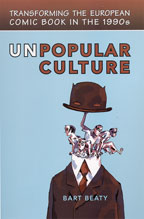
From the vault: Unpopular Culture

Note: This review originally appeared in issue #284 of The Comics Journal.

“Unpopular Culture: Transforming the European Comic Book in the 1990s”
by Bart Beaty
University of Toronto Press 320 pages, $29.95

I wasn’t surprised that Bart Beaty’s new book, Unpopular Culture would prove to be so readable. Anyone who’s followed Beaty’s reviews and essays in The Comics Journal, particularly his seminal Eurocomics for Beginners column back in the mid-1990s, ought to be well aware of how good a writer he can be. What did prove surprising to me is that a book so utterly and single-mindedly focused on the European market would actually have something to say, albeit in an indirect fashion, about American comics.

We Yanks tend to imagine the Europeans as being much more enlightened about the art of comics than our own countrymen could ever possibly hope to be. Why, they sell comics in honest-to-god bookstores over there! And not just in the science-fiction section! They write comics about detectives and other, alternative genres! Moebius is a celebrity! Surely Europe, or at least France and Belgium, is a cartoonist’s utopia! Reading Unpopular Culture will, if nothing else, clear that lie out of your mind once and for all.

Comics, Beaty argues, may be a popular medium in Europe, but there’s a big difference between being popular and being respected. The general European public, to say nothing of the intelligentsia, has largely regarded the medium as little more than kiddie fare for the past several decades. It wasn’t until the 1990s, when companies like L’Assocition and Fremok started publishing more art-driven, less genre-derived material, that comics started to be viewed less as some sort of bourgeois kitsch to foist on the dull-minded populace and more as a work of art in its own right, deserving of respect and acclaim.

And it is at this point bells should be going off in your brain if you know anything about the American art-comics movement of the past fifteen years or so. Despite the considerable geographic (and other) differences between the two groups, both seemed to come to prominence around the same period of time and share more than just a desire to overturn the status quo.

What exactly happened in the 1990s is the central thrust of Beaty’s book, and he meticulously goes over what he regards as seven key issues, drawing out examples from various publishers and individual artists to show how such a change came about.

It’s worth going over the individual chapters, not only to get a feel for how the book is laid out, but to also get back to some of those inevitable comparisons that keep cropping up. In the first chapter, Beaty shows how publishers like L’Association imposed a new aesthetic by deliberately setting itself apart from mainstream publishers like Dargaud and Humanoides. In the second, he discusses how many artists came to regard the comic book as an art object in its own right, both creating books whose very binding and choice of paper make the book want to be put on display instead of a shelf.

In the third he examines how the small press challenged itself by undergoing formal experiments like OuBaPo, and by transforming the mixture of text and art in unprecedented ways that in some cases stretch at the very definition of what a comic is or should be.

The rest of the book follows along similar lines. He discusses how autobiography has been used as a way for artists to declare themselves as separate from other, more popular genres. He looks at how the small-press comics movement has developed differently across the European continent. He talks about how indie artists like Joann Sfar have been absorbed into the mainstream comics publishing empire. And then he sums the whole shebang up in a winning final chapter by examining the career of Lewis Trondheim, who, as Beaty makes clear, embodies more of the changes that have gone on in European comics in the past decade and a half than any other artist.

In a wider sense, Unpopular Culture is really about the constant and continual pull between market forces and artistic choices; between the avant-garde and whatever accounts for the mainstream at any given point of time. It’s about how the avant-garde and small press define themselves by what they are not instead of what they are, thereby transforming the culture, becoming subsumed by it, and leaving the door open for another avant-garde movement to take its place.

These are issues that every art form, from cinema to prose, deal with on an almost day-to-day basis and it’s certainly not something which American comics are immune from. That being said, aside from the occasional mention of Julie Doucet or Craig Thompson, Beaty stays clear away from discussing American comics, leaving readers to draw their own inferences.

That’s probably for the best, as doing so would open another very large can of worms, but it’s hard not to think about how these issues affect American artists while reading the book.

One issue that doesn’t seem to be as strong on these shores as Beaty seems to describe in his book is the line of demarcation between the U.S. mainstream and the alternative movement. While cartoonists like Dylan Horricks and Gilbert Hernandez (not to mention Ed Brubaker) have written superhero stories for the big two, it’s hard to see any one creator in the art-comix movement moving back and forth with the ease that Trondheim does. The superhero market is just too narrow a genre to accommodate most alt-cartoonists’ unique idiosyncrasies and individual art styles.

Of course, for a long time Marvel and DC were regarded as THE ENEMY, but I wonder if that’s true anymore. The true enemy of publishers like Fantagraphics (or at least rival for their affections) may be mainstream book publishers like Pantheon and Houghton Mifflin since they’ve snatched up authors like Thompson and Kim Deitch by dangling the promise of greater financial reward in front of them. Chris Ware’s ability to shift from the mainstream book world to small indie houses like Drawn and Quarterly perhaps prove a better allusion to Trondheim’s successes than Horricks’ run on Batgirl does.

Of course, perhaps the most notable difference is that in America we largely see Deitch’s getting a book deal as a good thing, and not a betrayal of all we hold dear. It’s hard to imagine Chris Oliveros writing something akin to Jean-Christopher Menu’s Plates-Bandes (which Beaty discusses at length), railing at the mainstream market for trying to co-opt the small press.

I said Unpopular Culture was readable and it is. But it has a decided academic tome and readers expecting something more akin to the relaxed and occasionally snarky prose Beaty utilized in the pages of The Comics Journal may well trip over some of the meatier sentences.

Overall, Unpopular Culture is a superb, insightful and, I believe, seminal book that will undoubtedly be referenced again and again when talking not just about European comics, but art-comics in general. Obviously the more familiar you are with the works referenced, the more you’ll able to get out of the book (I’m not ashamed to say I was thrilled whenever a comic I owned was mentioned, as though I was a member of some secret club). But you don’t have to have Beaty’s level of experience and knowledge to appreciate the issues that he’s raising. Or enjoy the way he raises them.

Labels: ,

Wednesday, November 12, 2008

Graphic Lit: On comic books and the bad economy


Is the comic book dead?

Not comics the artistic medium; that’s never been better.

No, I’m talking about the comic book pamphlet. You know, 32 pages, glossy cover, staples in the middle, comes out on a monthly (or semi-monthly) basis? I’m talking about the physical, periodical format.

Is it dying?

That’s the question that came to my mind while reading “Love and Rockets: New Stories,” the latest collection of work by indie cartoonists Jamie, Gilbert and Mario Hernandez.

For decades, the brothers have serialized their stories in pamphlets before collecting them into trade paperbacks. Now, however, in an attempt to expand their reach into book stores, the publisher Fantagraphics has rebooted the series as an annual, 112-page graphic novel.

“It’s not eliminating the comic shop at all but just opening it up to book stores and any place that can rack books,” said Fantagraphics Director of Promotions Eric Reynolds, “We could have kept [publishing it as a pamphlet], but we saw the way the books sell relative to periodicals and it was kind of a no-brainer.”

(By the way “New Stories” is a fantastic collection. Gilbert and Jamie are at the top of their form.)

The format change signals a shift of some sort in my mind. There was a time, say, 15 years ago, when you could go into a comic book store on a weekly basis and had a wealth of indie titles to choose from.

Now, most of those creators have either abandoned the medium entirely or moved to a “graphic novel only” strategy.

“For [‘Love and Rockets’] to switch to book format is a vote of no confidence from guys who were there first in alt-comics market,” said Tom Spurgeon, who runs the Comics Reporter Web site.

But is this change exclusive to the small-press scene or will it affect larger publishers as well?

I’m not the only one who’s been asking this question. In a recent interview, Dark Horse (publisher of “Hellboy”) CEO Mike Richardson said “As far as pamphlets — especially with what I see happening with the economy — as much as we all love them, the traditional comic book is going to be harder and harder to sell, and harder and harder to make work.”

Here are a few reasons:

An aging fan base. Despite the popularity of films like “Dark Knight,” comic books seem to appeal to a largely older, male readership and there aren’t a lot of new readers coming in.

Emphasis on event-driven titles. Right now, big crossover events like “Final Crisis” and “Secret Invasion” are climbing up the sales charts. But how many times can you return to that “everything changes” well before readers get bored?

The economy. People like to say that comics do well in recessions, but if gas prices go up again or the economy worsens, will fans have to choose between heading to the comic store every week to get the latest issue of “Trinity” versus a trip to the grocery store?

Rising prices. Comics aren’t really disposable entertainment any more. Your average issue runs about $3-$4, and there’s every chance that price could rise even higher.

I called a number of local stores to see if the worsening economy had affected them or if they had seen a movement away from periodicals towards graphic novels and trade collections.

Most of them said that while they may have lost a customer or two, they haven’t experienced any significant drop in sales.

“Pamphlet sales have been up every year for the last six-seven years, even though prices are going up,” said Bill Wahl of Comix Connection in Mechanicsburg, noting that sales of graphic novels also have increased.

“The people who have money or credit are still spending. People living paycheck to paycheck are cutting back,” said Bob Newbury of Cosmic Comics in Harrisburg.

More significantly, several of them noted that superhero fans in particular felt the need to keep up with their favorite series on a weekly basis.

“We sell 40-50 copies of ‘X-Men’ but not a single graphic novel. Fans still want ‘X-Men’ on a weekly basis. There’s not a person waiting to buy it after the story arc is done,” said Ralph Watts of Comics and Paperbacks Plus in Palmyra.

And what would the death of the periodical mean for comics shops?

“What I tell people is the day that happens, we’re all done. There will be no more comic book stores,” said Newbury. “We need that repeat business.”

If you’re DC or Marvel, the periodical remains a viable publishing format, though that’s not necessarily the case for other publishers or genres (DC’s Vertigo line, for example, seems to sell much better in trade than pamphlet).

If this trend continues, or if longtime fans are forced to make tough economic choices, the traditional comic book format may go the way of the blacksmith and long-playing record.

“Just because something’s outmoded doesn’t mean it should be abandoned,” Spurgeon said. “I hope they don’t abandon it. There’s still money to be made.”

Copyright The Patriot-News, 2008

Labels: ,

Wednesday, November 05, 2008

Graphic Lit: The big debut


There’s something about the big debut, that new comic or graphic novel from a budding cartoonist suggesting great promise, that gets people (myself included) all fired up.

Of course, not every artist manages to capitalize on all that initial goodwill, but for those who do, it’s worthwhile to go back and re-examine their initial forays.

Take Scott McCloud, for example.

Before he became renowned for books like “Understanding Comics,” McCloud was best known for his superhero series “Zot!”

The comic centered around the titular hero, a carefree teen from another, futuristic dimension, and his relationship with Jenny, a decidedly more pessimistic girl from our Earth.

The new “Complete Black and White Collection” collects the later half of Zot’s saga (McCloud apparently not being terribly satisfied with its initial full-color run) into one brick-sized book.

Reading the series, you can see McCloud constantly experimenting, taking elements of mainstream comics, the burgeoning indie scene and manga (still new and strange back then) and trying to digest them to form his own style.

The first half of the book is mostly set in Zot’s world and is full of fun, zany, dramatic adventures.

Halfway through, McCloud abandons the superhero stuff almost entirely, focusing instead on Jenny and her friends and their everyday lives.

Combining freewheeling sci-fi tropes (robot butlers, flying cars) with realistic, fully developed characters, “Zot!” helped point the way toward comics’ full potential, a trail McCloud would blaze more fully a few years later with “Understanding Comics.”

Another series that initially dealt with superheroes only to change halfway through was “Demo,” which initially attempted to tell slice-of-life stories about teens and twentysomethings coming to terms with their burgeoning supernatural powers.

Brian Wood and Becky Cloonan then abandoned that tack in favor of exploring young people at crossroads in their lives, be it the end of a relationship or wising up to the fact that it’s time to grow up and get a real job.

Wood and Cloonan made their mark with these smart, well-grounded, emotionally involving tales, and while they’ve done great work since, I’m not entirely sure they’ve done anything that’s surpassed their early work.

But while we might look fondly at “Demo” and “Zot!” with the benefit of hindsight, stellar debuts are far from a thing of the past.

Witness “Swallow Me Whole,” a new graphic novel by Nate Powell. I’m not kidding when I say this book knocked me for a loop.

“Swallow” tells the tale of two teenage stepsiblings, brother and sister, each with different mental problems (the brother displays signs of schizophrenia, while the sister has a severe obsessive-compulsive disorder).

Powell’s tale unfolds in a relaxed fashion as the pair trudge their way through school, deal with family and try to cope with their problems.

Eventually, one sibling starts to get better while the other, tragically, does not.

Powell displays a poetic gift for visual metaphor here, articulating the kids’ illnesses with some deft imagery.

He also has an ear for realistic dialogue and situations (a cringeworthy incident at school, for example, seems particularly drawn from life).

In short, “Swallow Me Whole” is a fantastic book. Keep your eye on this Powell kid. He’s going places.

Copyright The Patriot-News, 2008

Labels: , ,

Wednesday, October 22, 2008

Graphic Lit: An interview with Art Spiegelman


It's no exaggeration to say that Art Spiegelman legitimized comics.

While he certainly wasn't alone, the Pulitzer Prize-winning cartoonist has been a tireless advocate of the art form and played a large part in shepherding its movement toward respectability.

But arguably nothing he did was as influential as Maus. His haunting retelling of his father's experiences in Auschwitz (with the Jews disguised as mice and the Germans disguised as cats)
helped many to see that comics could be more than superheroes and kiddie fare.

Now Spiegelman has a new book, Breakdowns: Portrait of the Artist as a Young %@&*! It's actually a reprinting of a little-seen collection of early experimental strips that in many ways laid the groundwork for Maus. He spoke from his home in New York City about Breakdowns and his legacy:

Q: What’s it like to revisit this material after so long?

A: Well, that’s what led to that 20-plus page part of the book was trying to understand what it mean to revisit it. What’s interesting for me is it doesn’t seem like juvenalia to me.

That’s the question being asked by my friends, “Doesn’t it feel weird to be showing work from whatever number of years ago?” And it does if I feel to directly attached to it. I’ll go “Oh gee, I really better redraw that part. It’s not right.”

I’ve been very proud of some of the achievements in the old Breakdowns. They’re as important to me as the whole Maus book thing. They were wrested out of nowhere. They were coming out of a context of no context as one of those New Yorker writers used to put it. I look back on those as landmarks for myself and -- it may be hard to say it about oneself but landmarks as to what kinds of comics could be made afterward, even though I didn’t have the facility of a Robert Crumb or the intense madness of a Rory Hayes or whatever. It was offering something new.

Q: Aside from the obvious — the initial Maus story and Prisoner on the Hell Planet — to what extent did these stories shape the structure and story of Maus?

A: Good question, cause I think it was essential. It’s not just a matter of the subject matter which is clearly urgently connected to Maus. Three-page Maus, one hundred-page Maus, you can see that there’s a link-up. But I think that the other material, ones where I found different ways of connecting panels and making your eyeball stutter, skip, jump and bounce in order to try to understand something.

Now the way I was doing it in Breakdowns was guaranteed to find me a very small if any audience, cause it was offering difficulties from a medium that was there to make things easy. On the other hand, all the things I was tinkering with to make you stumble and re-read, could be put together as a kind of Tinkertoy set, but rearranged so that instead of making your eyeball stutter it made your eyeball move. It was the same instruction kit, just putting it from Z to A rather than A to Z or whatever.

Q: Looking at Breakdowns and then reading Maus I can definitely see there’s a lot of the same experimentalism going on, it’s just more in service to —

A: It’s just totally hit and miss. I remember at the time I was reading a lot about Picasso in the 70s, which is what led to that Ace Hole comic strip. There’s a postwar issue of Life magazine where somebody said “What’s the big deal about Picasso? All painters do that except usually they finish their damn paintings.” (laughs)

That kind of impulse of "everything is here but it’s got to be finished so that people will be able to read it." On the surface it’s out of the way, but the way pages were thought about was very similar. It was just with the acknowledgment that people don’t want to think about the stories they enter into completely as a mere armature or hanger to drape something on. The reason they’ve come to the show in the first place perhaps.

Q: Can you tell me a bit about your influences on this material. You talk in the book about expressionist art and Picasso. What were you looking at the time —

A: You mean outside of comic books.

Q: And comic books too. The whole package.

A: Comics were my culture period. And then I came late to thinking about other things as worth looking at. I was almost like a slob snob. Certain things were exempt. As soon as I saw George Grosz’s work I thought “Oh, he’s a cartoonist and he’s a good one.” That was easy. It was one step harder to get to Picasso and several steps harder to get to ultimately people like Ad Reinhardt or Pollack or whatever.

There was a moment where I seemed to understand why they were doing that sort of thing and it wasn’t just to con me, which was the original paranoid thought. It’s better to think of politicians that way than painters.

In literature Kafka I got right away. It was just an extension of the Twilight Zone as I think I said in the introduction. But some of the other stuff, I think Gertrude Stein became important to me. I’ve returned to find it impenetrable, but there was a period where it was very clear. Reading James Joyce. Reading relatively difficult literature as well as my passionate embrace of Philip K. Dick at the time. Loving the noir-novels for their sentences than their stories.

These things sit in different proportions now. At this point, Philip K. Dick, well that’s a no-brainer. If you’ve ever heard of science fiction, that’s him. For me it was strictly finding a very obscure paperback that had a blurb on the cover that said “World gone mad and only a cartoonist can save them,” which fit in with my own messianic needs. It turned out the blurb writer only read the first ten sentences of the novel and thought that was what it might be about. Nobody ever knows what those books are about. But at that time that wasn’t an obvious taste. Nor was the noir stuff, which is now looming as I think one of the main genre achievements of the last century.

Q: What specifically led you to go down this experimental format? As you mention you were kind of alone in this. Your contemporaries were not doing this sort of thing.

A: It was like “Oh, here’s a whole other continent. While they’re colonizing that one, here’s another one!” The revolution in what could be handled in comics content was already well under way with Crumb and Justin Green and even the Furry Freak Brothers because all of the sudden Dagwood Bumstead was smoking weed. There was a content revolution definitely going on.

The thing was hanging out, not just with cartoonists, but really with underground filmmakers. In San Francisco there was George Kuchar, but in New York there was this guy Ken Jacobs who gets this special tribute, a set of panels, in the first part of the book. These were people who grew out of a much more rarefied — they were looking at stuff that was much more difficult. Not for sissy eyes, you know?

It took me awhile to get into it. I’d fall asleep at most of their film screenings cause there was no story. They came to film like abstract expressionists came to painting. Ken Jacobs was a student of Hans Hoffman.

It became clear to me at a certain moment that comics didn’t get to do the same kind of extending and growing that a lot of other mediums in the 20th century did. Why not? One of the reasons is that comics is one of the only ones that stuck with figure drawing at a time when it became really square to draw something representational. Comics were left alone to carry that mantle, but as a result they missed out on a lot of modernism. I was getting interested in modernism at the time, so it seemed natural to try to see what can comics do if they want to enter the same conversation. So that’s what led to that kind of work.

For me, because I’m a cartoonist, I wasn’t interested in something that I would argue about with these friends of mine all the time, which is that I think they saw communication as a nasty word. We’re not here to communicate. What do you mean? We are the "arteest." We are the shaman. We spread our entrails and others read them. I went to a commercial art high school. I was trained to become an advertising artist if I just didn’t have a contrarian ethical streak I could have made out as one of those mad men in the early '60s.

Communication per se was the natural province. I just thought maybe you could change where the communication took place. What are you communicating about? Is it urgent or is it just one more sublimated sexual fantasy, which is the way it was until they stopped being sublimated in the '60s, or is it just one more joke — nothing wrong with jokes. It was like changing the kind of conversation one could have and the thing seemed a miscalculation at the time but now seems more reasonable. One could change the demand one put on the reader to make that communication happen. That line changed, where that gate is.

Q: Yeah, it definitely feels like there’s more of a blending than ever before.

A: But it’s not like I feel comics shouldn’t communicate, because I think they should! That’s what we’re on the planet for. Yes, self-expression is communication as well. It’s not trying to mystify and keep people out. It’s a matter of just having a conversation that can’t take place without some vocabulary.

Q: You talk about this in the afterword, but can you just take me again through the publication history?

A: Oh god. The book came about only because I was doing comics that were easy to miss. I was doing short pieces, very concentrated, that sometimes would take me months, literally to do a page. In order to write that one-page poem I either had to learn Urdu or invent some other language to make that page. It took longer than just writing and drawing a page.

After I had done a number of those things I wanted to see them in their own context. It made me want some kind of collection of my own work and Woody Gelman at Topps Gum thought he was going to win the sweepstakes and had a lot of extra mad money for publishing and was inviting all of — this isn’t short it’s just fast — this guy offered me a chance to do a book. He was a small publisher who thought he was going to make a lot of money.

By the time he realized he was not going to make a lot of money publishing an Elvis Presley poster book my book was at the printer. Fortunately, one of the people I knew who was a porno publisher of dirty comics was willing to put this out even though he didn’t get it himself. I learned at that moment if not before that there really is a difference between printing and publishing. He helped me get the book printed but it never really entered the world. It was "privished" rather than published.

So this thing came out. It took a long time to sell what turned out to be only 3,500 or 4,000 copies after we threw away the ones that came out badly printed when the all-night shift at the printer got so interested in those erotic panels that they stopped looking at the presses.
There were relatively few. 4,000’s not a giant edition. It took a rather long time for those to feed out into the world. A number of those strips within Breakdowns did get printed and reprinted over the years. A lot of people did get to see the individual pieces of it.

At that point I thought that was it. I moved on and actually there it lay as one of the many odd evolutionary sports a hardcover, large size anthology of comics that didn’t seem to come either from a fine-art world or a comics world. It only came out as a book now because of things that happened on Sept. 11, which got me to want to make comics after we were in lower Manhattan for the festivities. The comics I was making then for some newspapers in Europe were things I was just doing to keep myself occupied while waiting to die in lower Manhattan.

Q: You’re talking about In the Shadow of No Towers.

A: Yeah. And I really wasn’t ever expecting that to become a book entitled In the Shadow of No Towers. I was just making pages. I wasn’t going to leave New York, I had vowed to make comics again. There was no reason for me to make comics again where I place the contractual connection between reader and me so far over to the side that I would be hampered in putting down what I needed to put down. When it did come out as a book and people started talking to me inevitably I’d start talking about the work I’d done in Breakdowns prior to Maus. It was at that time that my editor at Pantheon said “What’s this Breakdowns thing?” I showed it to him, he said Hey, we could publish this, it’s great.”

I was kind of shocked and glad, but first of all, as I relate in that essay at the end, I said “but what about these hardcore sexual panels” and he says “the naughty stuff?” Time has passed me by, I don’t know. I said "Yeah sure, if you want to publish it that will be great, I’ll just do an introduction" and then I realized I had vowed to return to comics after Sept. 11. So over two years later I have a 20-page introduction and therefore was able to re-contextualize the book a bit.

Because the first question you asked me is the one that the whole project is about. Looking back at that thing, what led to those weird bits in terms of their content and the peculiar interest they took in form. I thought this was a way to revisit that and make good on one concept I had in the Breakdowns years that I tried hard to realize and it just didn’t work. In the back part there’s that thing called Some Boxes for the Salvation Army. And that’s where I was excited about the possibility of editing a comic after you drew it, which meant making all the boxes the same size. I tried to do that for Arcade the magazine I was co-editing with Bill Griffith. Time ran out, the issue was due and I only made enough panels of the same size to barely last three minutes. Certainly not enough to do what I ambitiously wanted to do.

Those got published as some scrap and I moved on. But I was wistful because that was a good idea and I wanted to revisit it. This became an occasion to use that formal idea again — instead of the page being a unit, making the box the unit, so that the boxes could be 3,5,7, 15, 20, it didn’t matter wherever it ended something else would connect to it. It allowed me to set up different kinds of rhythms, repetitions, moving back and forth in time, and echo something about the way memory works and how conceptual things inter-cut with the memories and make other things happen. So that project became really exciting and I got to do a comic I was supposed to have done back in the '70s now. It was interesting for me to see how it connected to the work I did after.

In a way that long introduction is more friendly than some of the work that’s in the '70s Breakdowns, in terms of beckoning someone close enough to spend time with it. Because I’ve learned something about how to pace and tell an anecdote. It fell somewhere between what I was doing in Maus and what I had been doing in Breakdowns.

Q: Reading the material, in some ways I think it’s more revealing and personal than Maus.

A: Thank you for saying that, because I’m just beginning to have to talk about this thing and I’m realizing how hard it is for me, because I’m vulnerable here.

Q: It’s extremely vulnerable material. I was actually kind of shocked at some of the sequences, how revealing and personal you were. I hate to compare it to Maus, but maybe it’s because it’s taken out of the realm of world history to an extent.

A: Certainly the anecdotes were personal. That’s true. Those are anecdotes that were anecdotable. They weren’t the most wispy, visceral aspects of memory. They were the ones that one could tell someone else should one want to. You have some memories like “and then there’s the time five kids gathered after school and beat the shit out of me” and there’s others where you’re just feeling this horror at what it is to have to get through life and turn into an adult, but there’s no content. It’s just a feeling of horror.

That wasn’t what I was trying to communicate. I was thinking of the ones that were anecdotable and seeing what happens when you put those together in different temporal order and different emotional order and different stylistic order to see how they could fit together and give a overall feeling.

The other part that’s personal is the actual stuff that I'm just calling formal comics or an interest in structure. In a way that’s as personal as the content. Cause that’s the one where it’s about the kind of electrical impulses that carry thought rather than what the thought is. That’s rather intimate in the sense that it’s not as easy to talk about or demo as the content and yet it’s the one that’s about how I think. I just don’t know what to say. It seems really basic to me.

The page called Don’t Get Around Much Any More. OK, there’s some content there, it’s about feeling bummed out, depressed. But the actual way that content is expressed has to do with the ways in which the usual Tinkertoys have been arranged. And that rearrangement makes me experience the feelings that are being described when I talk about being depressed. But that’s more than just saying “I was really depressed, my girlfriend left me, or whatever.”

Q: You’re talking about trying to evoke a particular mood or emotion through the comic rather than simply issue a statement or go from a to b.

A: Right. It’s not just the content or parts of the comic. It’s the very way that comic is built. Is carrying the most urgent part of it for me. What I was describing before was trying to invent some new version of Urdu to be able to do a short strip. But those are the works that made me want this book to happen again because I’d like that to be re-entered into the mix even though it’s not likely that it can have the kind of audience that will go “Ah, I don’t know if I like this guy’s comics. I don’t read comics, but it’s about the Holocaust! And there’s this other thing about Sept. 11 and I was watching TV that morning.” So there’s some reason. Here it’s much more out there on it’s own terms. I don’t know what that means in the world but it does feel like it’s more intimate in that sense.

Q: It doesn’t necessarily have the hook to draw you in. How long did it take you to put the introduction together?

A: It was done over a period over two years. I keep doing other things of one kind or another at the same time, so it’s not like every day I come marching in with the same agenda until I get to the last panel. But a lot of my time was devoted to that. There was footage I didn’t use, there were a lot of sequences that didn’t make the final cut. There’s a lot of just trying to figure out how to do this thing. Sometimes things that looked like they should have been easy, even to me, took a long time to master something stupid and simple that anybody should be able to do if they call themselves a cartoonist.

Q: Like what?

A: There’s one sequence about the Dick Van Dyke Show. That drove me nuts. I knew what drawing style I wanted but it wasn’t anywhere near the vocabulary of drawing styles that I’m usually interested in. So sometime around 1960 or so there was a style called off-beat. It grew out of that Tom Terrific, Gene Deitch thing. It was moving toward a sort of advertising look and it always looked to me soulless even though it came from people like Gene Deitch and Virgil Partch. It came from a genuine interest in what people like Picasso and Paul Klee were doing when they were drawing. but by the time it entered the world of subway poster advertisements and stuff, it was about the most soulless kind of cartooning I could find.

So I had to find some way of approximating what that stuff was for me, because first of all, that’s exactly the stuff that was around at that moment, whatever year that anecdote was. At that time that style was definitely in the ascendancy, and I wanted it for that reason and also because it was about how that artificial humor stuff cracks up against something all too real and looks as artificial as it is. Canned laugh tracks and stuff. I need to make that thing look that way and it took me a long time to do that even though, what is it, like six panels or something.

Q: I think it’s about nine.

A: Oh good, so I got about half as much mileage as I thought.

I wasn’t trying to do these things as Exercise in Style Matt Madden pages let’s say. But I needed each sequence to be thought through in its own complete little world that I could hook up to the world next door. Sometimes it was more like Milton Caniff like, other times like 1930s cartooning and other times more anonymous.

Did you ever see the movie Hands of Orlac? It was this alien hand that you can’t control anymore. Some days the hand can move and pretend it’s a cartoonist’s and some days it doesn’t know what to do with a pencil or how it fits between what fingers. This allowed for that because I could move onto another one where a drawing style was more congenial and then go back.

Q: Not to harp on it, but the intro does feel more intimate, perhaps because you’re talking about your childhood or because you’re less overt in talking about the influence that the Holocaust continues to have on you and your family.

A: Well Maus was more in service of what you were talking about before which was where does history intersect with a personal story. This one, there’s still the smell of the ovens somewhere in the background, but I’m trying to deal with a more banal life, presumably like the ones my comics reader friends would have had as well.

That’s what I was trying to get at before when I said about anecdotable. Even though I was using my own memory, my memories are different from anyone else’s specific memories, I wasn’t interested in my memories as I was in the model of how memories work. I was using things that one could relate to even if one had different experiences.

Q: Tell me a little bit about the Toon Book Jack in the Box.

A: It’s funny because in a way that was coming at things from the exact opposite side of the highway. So here’s this one book that is made for adults willing to re-read. Because most of these things weren’t made to be read once and put aside, like, say, Garfield. They’re meant to be re-read and the only way to re-read is you start doing it once and then have to go back and eventually make all of these connections that I hope are to be found.

At the same moment, I’m working on something that will get kids to learn to read so they can re-read. And it’s coming exactly from some other side except the same issues were at stake, which is a lot of my stuff, even Maus, comes at more formal interest than a content interest. Obviously I am aching with the burdens of history that have been laid on my back when I was just trying to watch TV, but still the thing that made me do the book was not that, but "Ooo, a long comic that need a bookmark. That would be cool."

Most of the pieces in Breakdowns are easily identifiable as exactly that. On the other side there’s you want to make a comic that’s so qualified a kid who would otherwise be reading "See Dick Run" would be reading this, that it would feel richer. I was like that guy Georges Perec who wrote a whole novel without the letter E in it. That kind of limitation.

Here the limitation was the word list — words you’re supposed to know by the end of first grade. And I was starting from that the same way those "I Can Read Books," the Dr. Seuss books start from that list. On the other hand, the work for adults was coming from another set of self-imposed restrictions and limitations.

It grew very specifically out of the difficulty I had writing the essay at the end. There was a certain point where I realized it’s just too hard to say this stuff about yourself. It’s much easier to have professor so and so or a friend write about you and that functions as the essay. But I felt for this book I needed to do it. It was so hard I just gave up after awhile. There was a moment where I figured I’ll just get some art critic friend to blather on for some pages. I’ll give him the necessary data. And while I was at that point of giving up, Francoise is making this series of books that sounds really like a solid thing to do in the world. And that was sort of a vacation from butting my head against the wall of writing an essay about myself.

There’s this one strip in Breakdowns called Cracking Jokes, which Scott McCloud acknowledges as "Oh, you can make comics as an essay, I see." That particular strip, in the very first panel there’s a jack in the box with dicks hanging off of his jester’s cap. There’s a reference to the notion of the jack in the box as a way of overcoming fear and learning the pleasures of narrative.

In a way the jack in the box is the first story. the first time you’re willing to trust your imagination enough to take a little excursion, even if it’s a little freaky the first time around. You understand it won’t really hurt you so you get to put the jack in the box back in and anticipate happily that the little puppet will pop out again. That’s the essence of what gets people to get interested in stories that play with your anxieties and then release them. Right? I wanted that to be part of this comic, the jack in the box keeps coming out in a more scary way until he’s literally outside the box and behind the boy. I thought it would be a way of offering something — the book itself would become a metaphor for a jack in the box.

Did you have an actual physical copy to look at?

Q: Of Breakdowns? Yes.

A: Good, because I was unhappy to find out that most people, unlike you, you must work for a paper with clout, there’s very few of these until this week. They’re on a boat somewhere. It took forever to get them here. As a result people are looking at the pdf version. And printing them out god knows how. And the objectness of it is part of what it is. The cover of the '70s Breakdowns is a different weight of paper than the —

Q: You need to see it in the full color version.

A: There’s shifting paper stocks, in terms of the weight of the paper and the color of the paper, so you can describe that but it’s not the same as viscerally touching it.

I think that’s part of why comics are doing so well in book stores now. Most literature this point, if it isn’t already on the Kindle — I touched it once — seems like it will get there. It’s not that beautiful a machine. It looks like it was made in East Germany. The content works. You can pour various books in and read them. But you can’t pour comics in.

Q: At least not these kind of comics, certainly.

A: Even when they get to the point where they can print in color, part of what’s true now, generally, is the comics are some of the best designed books in book stores. They take advantage of their existence as an object.

Q: You’re regarded in the comics community as the “father of the art comics movement. Not just for Maus but for the role you and Francoise played in shepherding and proselytizing cartoonists in Raw magazine. Forgive me for using the term, but you’re seen as this father figure. Is that a role you’re at all comfortable with?

A: Not at all, because I know a lot about father figures. The first thing you gotta do is kill ‘em! Absolute first order of business. I didn’t read all of Douglas Wolk’s book when I saw one sentence that somebody showed me about my work that said he has to be cut down because he’s the largest poppy in the field. Something close to that. I’m thinking, wait a minute, I know nothing about opium farming but I know a lot about Freud and Poppy. Cut down. Poppy. I get it. There’s definitely some kind of castrate the father figure as quick as you can. I don’t know.

I feel like I’m still one of the tyros trying to learn the basics of a trade that some of my younger peers in their 30s have gotten under control rather easily. I have a very difficult time drawing. It never got easier. I’m still struggling with all that, but as far as being the father figure, I wish that weren’t the case.

I think what happened was I was just following my own nose and interests from a very early age. Back in the 70s it seemed very obvious to me that certain things were true like comics could be art. They don’t have to be, they can be propaganda, they can be pornography. And of course, certain kids of pornography and propaganda can themselves be art. But nevertheless, comics can be any old thing it’s just a medium. And I was interested in seeing whether I could get the same stuff into and out of comics that I was getting from other corners of the culture band.

That led to certain things like finding other people’s work that seemed to fit into that logic system and then making Raw with Francoise, at the time that was a band of outsiders. The artists in there were not on any easy to find a common denominator. It wasn’t even as specific as when we did Arcade where it was mostly San Francisco cartoonists. It was just trolling for people pushing at certain kids of edges.

Over the years, especially in the last few, it seems like those are the artists who are in the main tent now. Gary Panter and I had some kind of public conversation where we were talking about Chris Ware and said it was like a one-man Raw. It did open up a certain kind of zone. It was always with the understanding that it wasn’t the only zone.

I think some of the father figure resentment and anger at me, which sometimes scares the hell out of me really, is that it’s as if I was saying — you used the word proselytize. Proselytize usually means if you don’t believe in my religion you’re going to go to hell. I never had that attitude. I was just talking about what moved me. Stuff I liked. I wasn’t saying therefore you can’t like superheroes. You can do whatever the hell you want. If you hate my work and love Kirby’s work that’s fine. But there’s no reason for me to talk about work I don’t like, there’s so much I do.

Q: Well, you’re someone who has straddled the line between high and low art, especially in works like Breakdowns. And there seems to be a reluctance on the part of a lot of cartoonists and fans to view comics as high art. What are the dangers —

A: That’s a decent question. I think that’s why I was trying to talk about the communication arts, those things that are considered lowly. I don’t think writers have the same kinds of problems. Maybe certain poets. For the most part a person sits down to write a novel, they do their damnedest to make it rich, full of all they know and if not exactly entertain the same way a James Bond movie entertains, it will pull you in and give you something you can follow along with. The idea is not to see how many people you can get to not finish your book. By being involved in narrative they have a less problematic relationship to the notion of communicating.

One of the problems with some comics is when one is specifically going after the mystification that seems to surround certain aspects of painting — “This is a painting. You figure out why I painted it and you figure out where it sits inside the grand philosophical stream of what painting has been." That can get pretty goddamn dry. I really wasn’t after that. I wasn’t after dry. I wasn’t after drowning you in a sea either. It was really just trying to make a different kind of experience happen.

Right now I’m reading lots and lots of very old comic books because they’ve been uploaded. You’ve probably come across Golden Age Comics. I’ve been taking a lot of books down from there because I’ll never see them otherwise. 99.9 percent of it was real sludge. Really hard to plow through and sometimes it’s got a nice visual lick. But every once in a while you run across someone who’s going for broke. Certainly Krigstein was applying all of his intelligence to making that thing happen. Other people had a strong personality. At this point I have a renewed respect for John Stanley as I discover more of what wasn’t Little Lulu stuff I had grown up with and taken for granted.

One of the thing with Kurtzman was the whole anarchic project of making those war and humor comics, but part of what he was doing was finding a usable grammar for structuring a page. I find that really a pleasure to try to understand because it seems like a conscious effort on his part. There’s one thing he does where it’s three panels across with a progressive close-up. And that allows for certain kinds of visual beats to happen. I read somewhere several years ago that if he had three lines of text above the box in one panel he had to keep that the same in all three so you wouldn’t have different sized rectangles. That kind of thing of really thinking about how it all fits together on a page; I really like seeing that secret language. The stuff Picasso left visible because it wasn’t finished is part of the way certain cartoonists approach what they do and it’s really exciting for me to find it again and understand what they were thinking. Certain artists who were moving to the same frequencies with a larger obligation to make sure that one way or another it’s going to entertain those kiddies. Sometimes dealing with relatively dark materials.

Q: Getting back to your influence again, you wrote what is largely considered to be the Great American Graphic novel. I get the feeling frequently — and you mention it in Breakdowns — that you are very ambivalent about its success.

A: Well, yeah. On the one hand, I’m grateful. There it is. It’s obviously going to be the first line in my obituary. So there’s that. And sure, it’s great to have that.

On the other hand it weighs, not only on me, but I think it weighs on all these other cartoonists trying to make work as well. “Oh god, Maus is such a burden.” Not just for me but for the ones saying “But superheroes are good.” Or the ones saying “This a serious story so it’s going to have to go one on one with Maus.” It looms. Obviously it looms larger for me because I’m standing right next to the giant Vladek monument that’s portrayed [in Breakdowns].

It’s not like I necessarily need to make another long comic that needs a bookmark. If anything I’m wondering if I want any aspect of that paternity laid on me. Because there’s one thing that’s definitely part of what’s in both the introduction to Breakdowns and in the older work which is comics as an act of great compression. The idea of a drawing to me is not to make an Alex Ross painting in a comic book. It’s never been a goal. I don’t like looking at it. It’s very skillful but it has nothing to do with me.

But I am interested in highly compressed visual information, what can be fit into a box and be readable and make it composed well. It involves relatively simple marks. That’s what made me want to do comics to begin with. When I was getting that cartooning kit at the age of seven or so. Also the language has to be very compressed, literally, in order to make balloons that are not just insanely tedious, twelve lines of balloon dialogue for each box. It’s an act of real compression there. It’s an act of compression for me.

It’s interesting to me that some people will do comics in which somebody is going down a flight of stairs for twelve pages but unless it’s really about the staircase, it seems to me it’s like watching somebody knit. Staircase, you’ve gotta get on it, you’ve gotta get off it. I think that’s two boxes. And it could be there’s a reason, I’m not saying there can’t be a reason. But very often there isn’t a reason except that the artist is very patient and willing to draw a subway from twelve different perspectives as the guy’s riding uptown and it takes as a real subway ride would take.

I’m more interested in that kind of compressed storytelling. In a way I think Maus is an act of compressed storytelling, event though it is about 300 pages. But if I was approaching it with some of the rhythms of other work I’m seeing coming out now, it would have been 1,200 pages. So not everything requires that breadth of paper to make it happen. It seems to me it has uses in terms of marketing. It’s nice to be able to fall into one long work. But in terms of making, it doesn’t necessarily seem like it uses what comics do best.

Q: What do you make of the resurgent interest in comics these days? Do you look around and think “I had a hand in that?”

A: Well sure. I’m proud of that as well. I think it’s great what’s happening because by making that landscape more visible to people and beckoning people towards it, it allows room for all the Johnny Ryans of the world as well. All of the wiseguy cartoonists who are all about shit, piss and id. Their outlaw culture is closer to graffiti than wall art. Bad example because graffiti crossed over, but you know what I mean.

The thing is that can happen once theirs a grid that includes an audience, and this new audience has to come along with the notion that oh, one doesn’t have to cast aside childish things, one can just let those toys grow up as well. That’s a great thing.

On the other hand, my more pessimistic side sees it as one more fad in a medium that has a history of fadness.

Q: That was my next question, do you think it’s sustainable?

A: Well I don’t think it will ever go back to the darkest days of 1980, when there was this total, arid landscape around us. But it will certainly settle down because when you look at it, it’s like the Yellow Kid became a fad, used to sell stuff, seeds to plant, tobacco and whatever. And that encouraged more stuff which soon became, there must have been about 40 different anarchistic kids dynamiting their parents in between 1898 and 1915 or so. It was a fad. And in an ongoing way, each of these landmark strips set off endless things like them. Things that looked like Terry and the Pirates were everywhere after Terry and the Pirates or — this is more scholarly than you need — but when Roy Crane got it going.

But certainly with comic books the same thing happens. After Superman there’s thousands of trannies in the area. And I think in a way the graphic novel’s following in that great tradition. There were horror comics, there were teen comics, now there’s long comics. I think it will all find it’s place eventually, but now at least there’s something happened. Comics won the trifecta.

Q: What do you make of the manga boom? It seems like it’s a part of what you’re talking about and at the same time very separate.

A: Yeah. What I was thinking of was that the trifecta consists of these things that happened but weren’t directly connected simultaneously. The manga boom? My jury is out because I’m not all that interested in — I get restless. I haven’t found a thing that would take me from beginning to end of a long thing happily.

Q: Have you read any of [Osama] Tezuka’s work?

A: Yeah and I like that best. I read the Buddha book and liked it because I was so surprised. It would go from slapstick to philosophy to violence and pathos, careening through. I didn’t know what to make of it because the cultural contexts didn’t make it clear whether that was the norm or this was strictly someone who needed better meds.

I liked the Buddha books. I like some of the Phoenix stuff. The guy I really, really like and would love to read more of in English is this guy named Yoshiharu Tsuge, who we published decades ago. He’s not receptive to the idea of it being translated, so most of its impossible unless you find scantillations, but he’s as good as Tezuka even in the eyes of japanese comics scholars.

Q: He’s the guy who did Screw Style?

A: Yeah. There’s that and then there’s some more autobiographical stuff, some of which came out in Raw. We did one about an electroplate factory and one about a girl’s first menstruation called Flowers. Those have a kind of — they at first seemed decompressed, but then you find out just how amazingly compressed they’ve been, especially the autobiographical stuff. He’s really been great, and at some point some Japanese artist was explaining to me that there’s the two great mountains of manga which Tezuka and Tsuge, even though Tsuge produced a total, he’s almost as unprolific as me by Japanese standards. He only made 800 or 10,000 pages as opposed to Tezuka’s 20 billion.

But I am interested in it. Certainly I’m interested in seeing that here’s something that unlike whatever we call it — art comics, independent comics, underground comics — there’s something else happening here which is comics as real entertainment the way they were when comics were at the center of the media pile. Specifically it was the ones for girls that made it all happen because they were so neglected that they were even willing to read from right to left.

There’s another thing that ties in which is the movies and comics business now. I think there it’s more the content of comics is migrating over to film and its because it’s no longer necessary to draw a person flying if you want to see a person flying. It’s readily available software. In a way the one franchise comics still had back in the '50s is no longer theirs alone. As a result, a lot of comics just seem like storyboards for film projects. It’s not directly connected with the alternative comics or the manga thing but it’s a third way in which comics have entered into high visibility.

Q: What are you working on now?

A: Right this minute before I go on a book tour that’s making me quake, I’m doing something for McSweeney’s. The people at McSweeney’s wanted to do a more stand-alone version of that sketchbook. They said let’s expand it and I said well, there’s only about two more drawings you didn’t publish, so how do we do that? After a bit of stumbling around what I’m doing is the hardcover edition of that sketchbook plus two other sketchbooks from different periods in their own format and size. They’ll be bundled together with something that looks like a book strap and a booklet about the sketchbooks. There’s one from '79 when I was starting Maus. one from 83 at the height of the Raw years and the one you just saw as a bundle of books and I’m just trying to get it all done before the book tour.

Q: Wow. When’s that coming out?

A: I think as early as February. And it will be called Be a Nose. One book called Be, one book called A, one book called Nose. There’s a movie called Bucket of Blood, a Roger Coreman cheapie horror comedy from about 1960 in which this guy named Walter Paisley who works at a beatnik coffee shop and realizes he’s not getting any of the girls, the painters and poets are. So he tries to be an artist. At the beginning of the movie he’s got this giant lump of clay and he’s pounding at it, trying to make it into something and he’s saying “Be a nose! Be a nose!” and he gets really frustrated and throws the knife he’s working with across the room and it accidentally kills his cat. He puts the cat in plaster and it’s his sculpture. The girls like his sculpture, it’s called “dead cat” and the girl goes "oh, that’s a cool title" and he gets the beatnik girls.

That thing pounding helplessly going "be a nose" is how I feel my creative process works. and the sketchbooks are a doorway into that process.

That’s what I’m working on at this very second. And then a larger scale I’m thinking about, not the content but the way the portrait of the artist section in Breakdowns is made is still interesting to me, so I’m trying to see what I can build with that. That thing of working in short spurts and putting them together later, so that each chunk can be drawn differently and have a different take on something connected to a larger whole.

I’m also working on Meta-Maus which is the Criterion DVD extra disc of Maus, before I finally put all this stuff away — the sketches, transcripts, etc.

Q: Is that actually going to be a DVD?

A: Well there was something that came out back in the day.

Q: I have a copy of that.

A: You can’t play it anymore, right?

Q: No, I don’t have HyperCard anymore.

A: Nobody does and I’m trying to figure out how to — I can’t reconstruct it, it would be too much. I was hoping and some tech people in Vancouver are trying to figure out how to at least make it in its own primitive way functional by mounting the files onto Flash. That would become the disc that would be associated with the book version that would be something similar, like there’s a long interview that will run through as text and then the rough sketches, alternate drafts, notebook drawings that connect to it, historical photos. We’re going through all that stuff before I can finally pull it out of my studio and get new shelf space again. That’s the more selfish motive for it. It’s also so I’ll never have to explain why mice ever again. (laughs).

So there’s that project in the works and then there’s another one which is an outgrowth of finding all these old comics online and looking at them again which is a big treasury of comics for kids. It’s well under way now. I don’t think it’s been publicly announced yet, but we’ll do it with Abrams.

I think that should keep me busy for the next couple of years.

Labels: ,