Tuesday, February 26, 2008

From the Vault: Formerly Known As The Justice League

Sorry for the media black-out recently. Been very, very busy here without much sign of letting up. I'll try to put up some new posts later this week, but for now, here's a review from TCJ #267

“Formerly Known as the Justice League”
by Keith Giffen, J.M. DeMatteis and Kevin Maguire and Joe Rubinstein
DC Comics
$12.95

Your enjoyment factor of “Formerly Known as the Justice League” is entirely predicated upon your knowledge of and love for the DC super hero universe. More specifically, it’s especially dependent upon your familiarity with the “Justice League” series that Giffen, DeMatteis and Maguire shepherded back in the late 1980s to early 90s. This rather popular revamp was notable mainly for its emphasis on humor, putting a bunch of second banana spandexed heroes through their usual paces while having them talk like Lucy and Ethel.

At the time it must have seemed rather innovative to take such a tongue-in-cheek approach and have tried and true DC characters act boorish, petty or inane, all the while spouting pithy asides and one-liners. And when it worked – when the humor came out of the characters and was leavened with some emotional weight -- “Justice League” was one probably one of the better super hero books going at the time. When it didn’t, which could be often, especially towards the end, the series was like a tiresome sitcom that has long since passed its initial cleverness and rushed straight long into unadulterated camp.

This new collection brings back the original creative team to perform what could best be described as the comic book equivalent of “Return to Mayberry.” It’s better than that, though it does fall into enough overly jokey lapses to irk those who don’t care for this kind of thing. Giffen and DeMatteis have a tendency to overplay their hand. I could have done, for instance, without the witty banter from the overly erudite thugs that attack the team early on, or the way every character’s comment has to be undercut with a reflective muttering of some sort. On the other hand, I did smile at their portrayal of Wonder Woman as priggish, self-righteous snot, and the notion of a super hero complaining about his heart condition was amusing enough to keep me engaged. So, in short, fans of the original series will be pleased with this brisk nostalgic walk. Newcomers to “Formerly” should only pick up the book if they’ve ever taken the time to find out who Booster Gold and Captain Atom are.

Labels: , ,

Tuesday, February 12, 2008

Graphic Lit: The Boys & Black Summer


Two weeks ago, I wrote about a handful of superhero books that anyone could go and pick up without needing to dig into 20 pages of backstory or worry about an excess of blood and guts.

They weren’t necessarily the most family-friendly titles out there, mind you, but for those searching for a capes and cowl thrill, they fit the bill nicely.

Now it’s time to look at the flip-side of the coin: books that embody what Comics Journal online editor Dirk Deppey terms “superhero decadence.”

The idea is that under pressure to constantly up the ante, publishers fill their comics with more and more sex and violence in order to cater to an increasingly older and jaded audience, one desperate to have their superhero comics “matter.”

One of the best examples of this growing subgenre may be “The Boys,” a satire by Garth Ennis and Darick Robertson.

Set in a world much like our own (only filled with superheroes), “The Boys” is about a group of government operatives who keep tabs on the various hero elements and make sure they toe the line when necessary. It goes without saying that it’s often necessary and that toeing the line involves beating them to a bloody, mangled pulp.

The moral center of the comic is Simon Pegg-lookalike “Wee Hughie,” who joins the team after his girlfriend is accidentally (but very brutally) killed by the hero A-Train.

The superheroes in this series are far from admirable. Though they maintain a veneer of moral authority, behind the scenes their ranks are filled with rapists, murderers, money-hungry charlatans, drug addicts and sexual deviants.

None of that should surprise those who’ve read Ennis’ other books, like “Preacher.” Many of his recurrent themes, such as the need for personal responsibility and ethics in a corrupt world, surface here, and as always he revels in going as far beyond the pale as possible.

“The Boys” walks a fine line. It veers wildly at time between uber-gross-out satire and serious character study. It’s clear Ennis and Robertson want you to care about their characters, particularly Hughie. When you do, it’s a compelling, if overly coarse series. When you don’t, it’s just coarse.

“Black Summer” by Warren Ellis and Juan Jose Ryp isn’t a satire, but it deals with a number of the same themes as “The Boys,” namely the dark side of the superhero fantasy.

The story begins with a bloody bang as hero John Horus decides he’s had enough of the Bush administration and their “illegal” war and slaughters the president and his cabinet.

That action creates quite a bit of trouble for Horus’ former teammates, known collectively as the Seven Guns, a loose group of genetically and cybernetically enhanced twentysomethings who have since fallen on hard times and, in the case of one member, rendered him a cripple.

As every military and federal agent attempt to take down Horus and, by extension, the other guns, philosophical questions are batted around like, at what point does a personal quest for justice and freedom edge into fascism? When do you stop being a do-gooder and become a dictator?

Of course, those questions take second seat to panels of stuff getting blowed up real good. And I mean real good. Ryp’s art owes a lot to Geof Darrow, of “Hard Boiled” fame. His pages are as overly and expressively rendered as possible, with no negative space to be found and every drop of blood, meat and bone drawn in the sharpest light.

Like “The Boys,” “Black Summer” wants to have it both ways, to shock you with its violence but thrill you at the same time. That’s about as good a definition of “superhero decadence” as I can come up with for now.

Copyright The Patriot-News, 2007

Labels: ,

Monday, January 28, 2008

Graphic Lit: Superheroes

This week's column is a pretty good example of why I started this blog, in that I had to cut over half the content out in order to fit it on our ever-shrinking newspaper page. Our editorial space keeps being cut drastically. It's not anyone's fault, I'm just stuck in a dying business I guess. Either that or I write too damn long.

Anyway, here's the column as originally intended.


It’s tough to be a superhero comic these days.

As the core fan base grows older and more demanding for “serious” (i.e. excessively violent) stories, it can be difficult to attract new readers.

You see, the older the character or universe gets, the more complicated and esoteric its history becomes. Trying to placate fans who’ve spent time and effort investing in a hero’s lineage while also attempting to bring in new fans can put one in considerable hot water.

Take the recent debacle involving Spider-Man for example. Longing for the days when Peter Parker was a swinging (pardon the pun) single, the powers that be at Marvel decided to undo his marriage with Mary Jane — not through divorce or trial separation but by having him make a deal with the devil, erasing his marriage from existence in order to save his beloved Aunt May.

Reaction was swift and derisive, if not downright hostile. Many longtime fans threatened to stop reading Spidey’s adventures while newcomers may have found the premise too laughable to invest their cash.

Still, high-quality cape and cowl books do exist, if you know where to find them. Here are four titles currently being published by the big two — Marvel and DC — that you can walk right into your local comic shop, pick up and enjoy without having to have a master’s degree in Superherology:

“The Immortal Iron Fist”
by Ed Brubaker, Matt Fraction, David Aja, Marvel, $2.99 per issue.


Brubaker, Fraction and Aja do the rather impressive feat of taking an up-till-now negligible C-list character — martial arts expert Daniel Rand — and suddenly making him relevant and interesting by positioning him as the latest in a long line of “Iron Fists.” The added back story gives the book some gravitas and weight while still managing to be a fun, gritty kung-fu homage. (Note: The first six issues have been collected into a $14.99 trade, “The Last Iron Fist Story.”)

“Omega the Unknown”
by Jonathan Lethem, Farel Dalrymple and Paul Hornschemeier, Marvel, $2.99 per issue.


Originally created by Steve Gerber and Jim Mooney in the 1970s, Omega was an idiosyncratic comic about an overly intelligent teenage orphan and his mute, enigmatic superhero guardian that lasted just long enough (10 issues) to develop a cult following.

Acclaimed novelist Lethem (“Fortress of Solitude”) and indie artist Dalrymple’s 10-issue revamp tries to pay homage to the original’s offbeat tone while creating its own quiet, surreal feel. It takes a few issues to build up steam, but by the third you can sense it simultaneously creating an aura of mystery and dread that makes you eager to pick up the next issue.

“Booster Gold”
by Geoff Johns, Jeff Katz, Dan Jurgens and Norm Rapmund, DC, $2.99 per issue.


Like “Iron Fist,” “Booster Gold” also focuses on a third-rate hero, in this case an attention-seeking showboater from the future. The catch here is that Booster finds himself becoming the savior of the DC universe by having to travel through time and fix anomalies so that, say, Superman doesn’t end up as Lex Luthor’s little brother.

Perhaps the most impressive thing about the comic is that while it’s clearly focused on DC minutiae, it doesn’t become mired in it. It’s more than happy to explain itself to the unfamiliar reader who doesn’t know or care who Rip Hunter or Jonah Hex are. It sets up its rules, explains them concisely and then goes about its business, namely creating a fun adventure.

It’s also rather genuinely funny, which is not something you can say about a lot of superhero books these days.

“The Brave and the Bold”
by Mark Waid and George Perez, DC, $2.99 per issue.


Superhero fans love a good team-up, and “Brave and the Bold” attempts to scratch that itch in spades. In the first story arc (now collected into a hardcover $25 book, “The Lords of Luck”) Batman, Supergirl, Green Lantern and many others travel back and forth through time to retrieve an item of dire importance. The plot’s just an excuse to have these colorful characters bump up against each other, and it’s fun to see, for example, the uber-professional Batman rub shoulders with the nervous neophyte Blue Beetle.

It sounds like the sort of thing only hard-core DC nerds would appreciate, but Waid and Perez bring a light touch to the project — there were characters here I wasn’t aware of or familiar with, but I didn’t feel left out once. It’s a fun thrill ride of a book. 
Copyright The Patriot-News, 2008

Labels: , , ,

Monday, June 11, 2007

My editor asked me to do a "Fantastic Four" story

This is what I came up with:


No doubt you’ve seen the promotional material for the latest Fantastic Four film — a movie trailer here or a billboard poster there — all bearing the iconic image of a metallic man zooming across a gleaming surfboard.

That figure, known by the descriptive title of the Silver Surfer, (hence the film’s title: “Rise of the Silver Surfer”) has made a number of devoted Fantastic Four fans excited and hopeful for the new sequel.

Though he’s never captured the public imagination in the same way as Spider-Man or the X-Men, he remains a strong supporting character within the Marvel Universe, one with a strong fan following.

For those interested in the film but not familiar with the character, however, a bit of back story might be required.

The Silver Surfer first appeared in March 1966 in Fantastic Four No. 48 as the herald of Galactus, a planet-eating, space-faring giant who thought Earth might make a nice late-night snack.

Created by Stan Lee and Jack Kirby, the “Galactus Trilogy” is regarded by many as one of the best superhero stories ever, an epic, lofty blend of science fiction and action tropes.

Persuaded by the Fantastic Four that Earth is worth saving, the Surfer betrays Galactus, who ultimately spares Earth, but not before exiling the Surfer to the planet forever.

Now a regular part of the Marvel Universe, the Surfer quickly got his own regular series and a new origin.

Turns out his real name is Norrin Radd, an ordinary Joe from another world who volunteered to become Galactus’ herald in order to spare his home planet.

Forever separated from his true love, Shalla-Bal, the Surfer, when not battling the forces of evil, was often given to bouts of expository self-pity, as well as philosophical musings on man’s inhumanity to man. (“Is it but in desolation that man can find the peace he seeks? Was it for this that I renounced my heritage?”)

That original series, written by Lee with art by John Buscema, lasted only 18 issues, but the Surfer has appeared regularly in a variety of Marvel titles in the decades since, including a second series that lasted 194 issues.

The character was a particular favorite of Lee, to the point that for many years he requested that he be the only one allowed to write his adventures.

So what’s the appeal of a silver-plated guy who roams the cosmos on a fancy boogie board?

“The Surfer, when done well and properly, is best as the alien observer on our culture,” Marvel editor Tom Brevoort said. “It’s about being able to take a look at mankind from an outsider’s perspective and hold up a mirror to ourselves and our foibles.

“While he may not be as popular as a Spider-Man or an X-Man, he’s in that solid bedrock of perennial Marvel characters,” he said. “Even though he hasn’t had a movie of his own, people seem to remember and recognize him. There’s an essential Marvelness about him. There’s something about him that sticks in people’s imaginations.”

-----

I asked Marvel Universe editor Tom Brevoort to list five Silver Surfer books that would allow the uninitiated to get up to speed. Here’s what he picked: 

“The Silver Surfer Omnibus.” This $75 “dictionary-sized hardcover” collects all 18 issues of the original series — including the letters pages — plus various odds and ends. “It’s your one-stop shopping for surfer information,” Brevoort said. 
“The Essential Silver Surfer Vol. 1-2.” A more affordable version of the omnibus, these black-and- white softcovers collect 500 of reprint material, from the 1960s onward. 

“Marvel Masterworks: Fantastic Four Volume 5.” This $50 hardcover collects the “Galactus Trilogy,” the first Silver Surfer story. 

“Silver Surfer: Parable.” Written by Stan Lee and illustrated by French cartoonist Moebius. Brevoort describes the plot of this standalone story: “Galactus’ return to Earth is turned into a subject of worship by an unthinking humanity, and the Surfer must again stand in defense of mankind even against itself.” You might have to dig around a bit to find this one. 

“Silver Surfer Requiem.” The Surfer faces his own mortality in this new, ongoing series by J. Michael Straczynski and Esad Ribic. $3.99 each.


Copyright The Patriot-News, 2007

Labels: ,

Wednesday, November 29, 2006

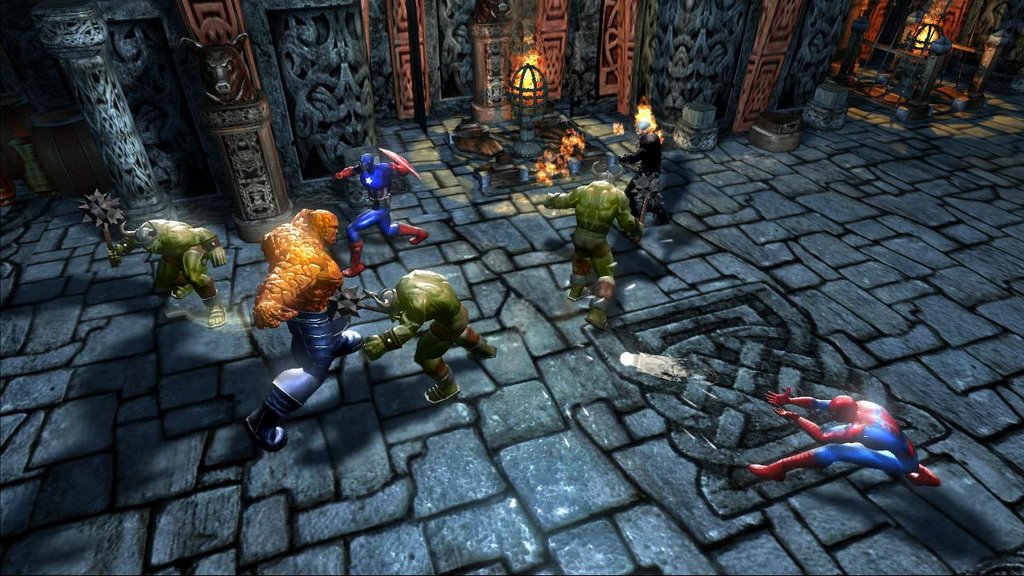
VG REVIEW: Marvel Ultimate Alliance & Justice League Heroes


“MARVEL ULTIMATE ALLIANCE”
Activision, for the Wii, PlaySta­tion 3, Xbox 360, PlayStation 2, Xbox and PC
rated T for Teen (mild language, violence), $59.99 (360 and PS3), $49.99 (Wii) and $39.99 (all others).

“JUSTICE LEAGUE HEROES”
WB Games, for PlayStation 2 and Xbox
rated T for Teen (fantasy violence, mild language), $39.99.

The Three Stooges vs. The Marx Brothers. The Beatles vs. the Rolling Stones. Marvel vs. DC.

While some of us are more than happy to sample from both sides of the fence, there are die-hard fans who must emphatically choose one party over the other, especially where Marvel and DC are concerned.

Thankfully, there are two new games out that should satisfy both camps: “Marvel Ultimate Alliance” and “Justice League Heroes.” Both games are similar in approach and design, and both are enjoyable, though one edges ahead in quality.

The play structures and plots of each game are similar. In both, a group of villains has banded together, collecting strange items for some ultimate nefarious purpose.

In both games, you control a group of heroes in an isometric environment, looking down on them from above. In “Alliance” you have a group of four. In “Heroes” you have only two. You can unlock more heroes, costumes and other items as you progress in either game, however.

Each hero has his own collection of special powers. In “Alliance,” for example, Captain America can throw his shield at enemies, while Spider-Man can fire webs at them. In “Heroes,” Superman has heat vision, while the Martian Manhunter fires psychic blasts.

Both titles do a good job of keeping their individual characters distinct from one another. Zatanna the magician doesn’t play the same as Batman, nor does Thor require the same strategy as Wolverine.

As you progress in each game, your characters gain new powers and abilities as they level up, and you can boost their health and general statistics along the way, too.

The games bears a strong resemblance to the “X-Men Legends” games, which is not surprising, especially in “Alliance’s” case, as it shares the same developer.

The biggest problem in games of this ilk is the tendency to rely on hack and slash repetition, constantly coming up against the same types of enemies and mashing the buttons over and over again to the point of banality.

“Alliance” does the better job overall of avoiding that pitfall through its larger cast of characters, greater variety in powers and better overall level design.

That’s not to say “Heroes” is a shabby game — it’s not. It’s just not as polished as “Alliance.”

The best thing about games like these is they allow fans to enter into the shared superhero universe that both publishing companies have been actively structuring with finesse for years.

To their credit, both “Heroes” and “Alliance” do a good enough job of delving into those worlds to please their hard-core constituents. But if you’re not taking sides, then you’ll be perfectly happy with “Alliance.”


Copyright The Patriot-News, 2006

Labels: ,